
Monitoring for modular data centers.
Set up once, live on every module.
One Aravolta node per module reads its UPS, PDUs, cooling, and sensors, and puts every site on one screen. Map the first unit once. Every unit after it ships pre-configured and reports when it powers on.
“This was by far the easiest setup and the most impressive monitoring system I've encountered.”

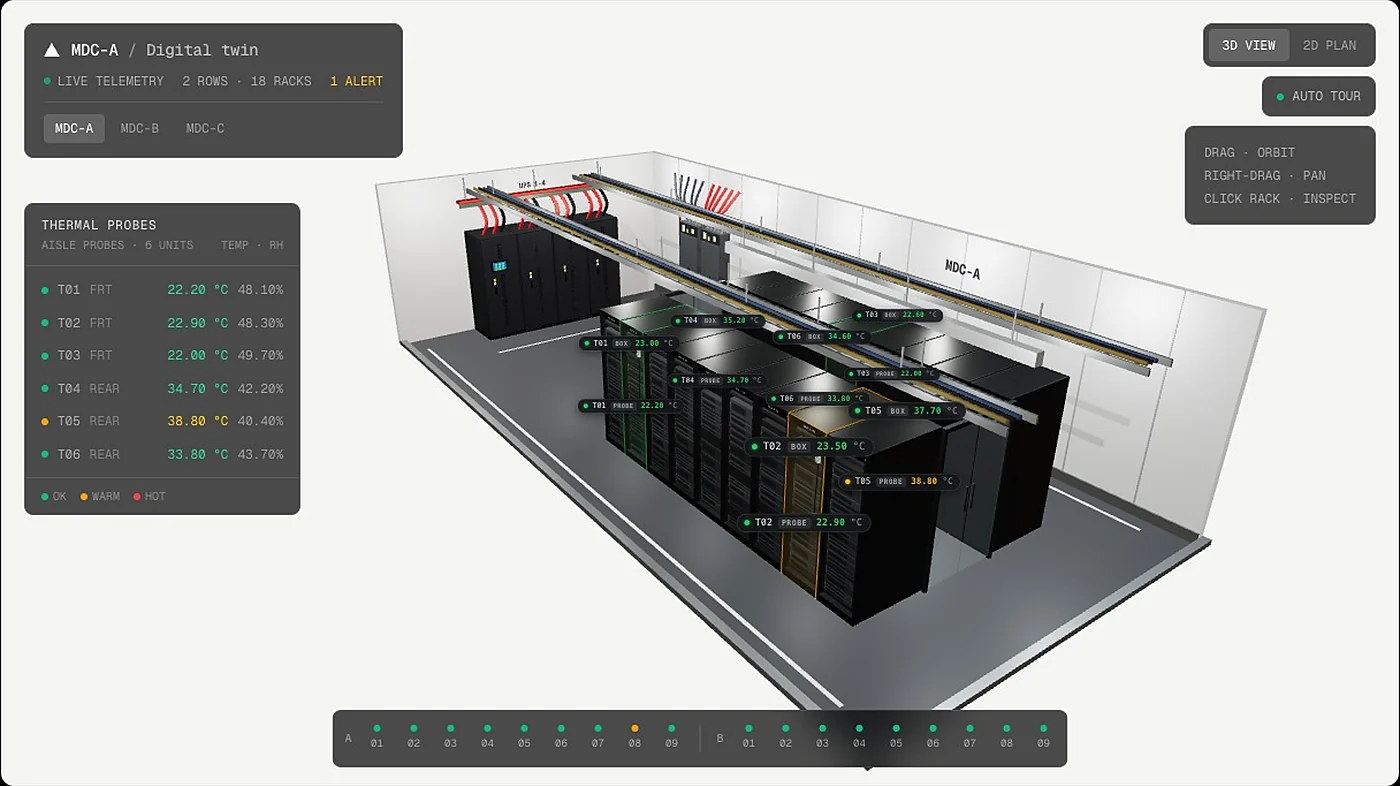
Fully operational in weeks, including support for liquid cooled systems.
Monitoring, alerting, asset management, and a digital twin at a modular data center.
One template for every module
Containerized halls repeat the same layout, so most of the setup happens once. Each new unit starts from the template and only confirms what it finds.
- 01
Map the first module
The node scans the module network and identifies its UPS, PDUs, coolers, and sensors. We build its twin from your drawings.
- 02
Save it as a template
Its dashboards, alert thresholds, and twin become the template for that module type.
- 03
Ship it with every unit
Each new module's node ships pre-configured. On power-up it scans the subnet and matches what it finds to the template.
- 04
Run them as one fleet
Every module joins the same map, alert list, and reports, wherever it sits.
Monitor every site from anywhere
Every modular and edge site on one screen, however remote it is.
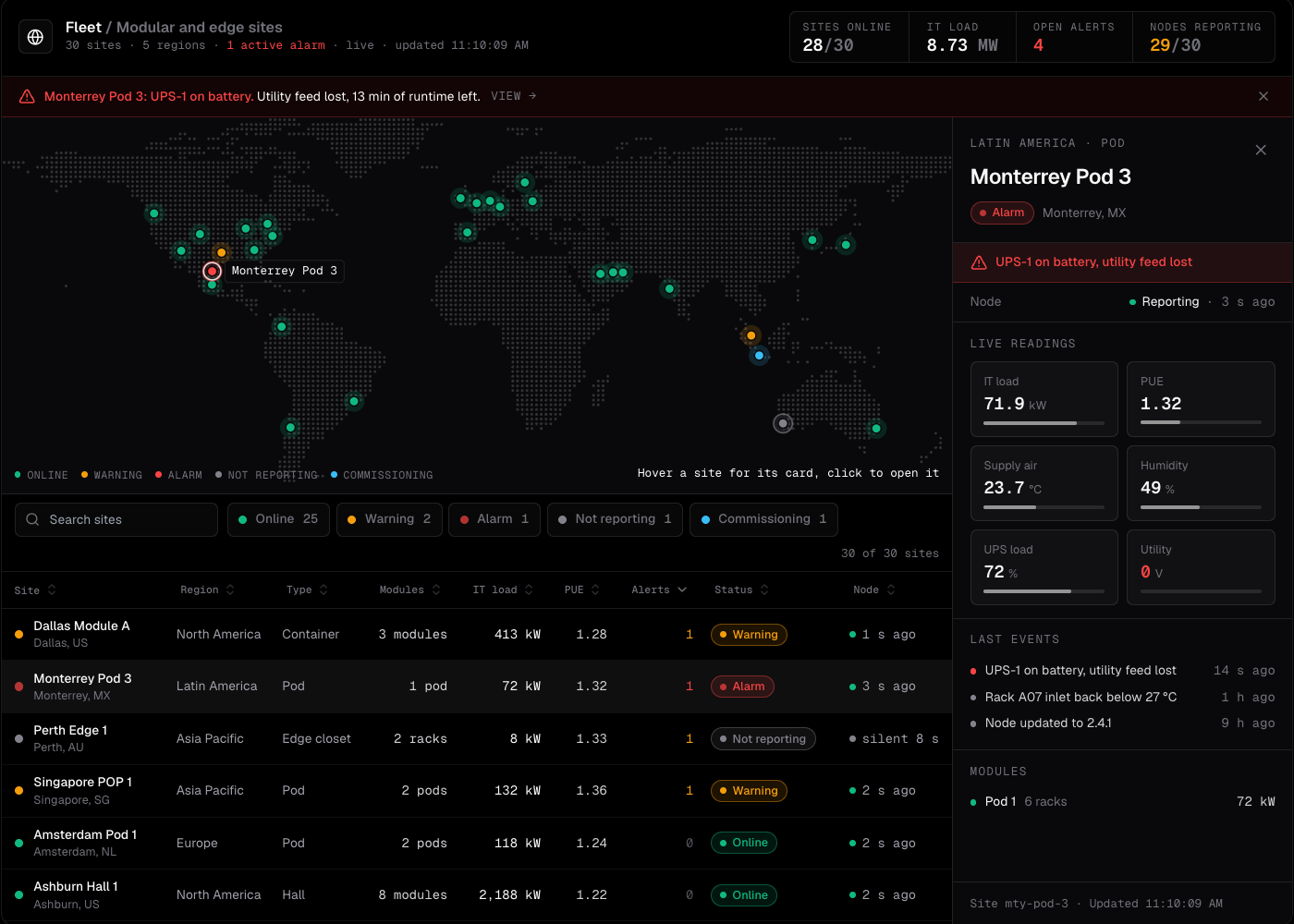
Sample data. We place your sites from their addresses and build each module list from your equipment list at onboarding.
What the node reads
Power, cooling, environment, security, and IT in one database, over the protocols the equipment already speaks. Your existing BMS keeps running; the node reads it alongside everything else.
- Power
- Power draw and distribution, UPS load, battery health and runtime, generator status and fuel, power quality
- Cooling
- CRAC and CRAH setpoints and performance, CDUs and coolant loops, chillers, airflow and pressure
- Environment
- Temperature and humidity across the module, water leak, smoke and fire, outdoor weather
- Security
- Door locks and badge readers, entry logs, camera feeds and motion events
- IT
- Server and network device health, storage status and capacity
- Protocols
- BACnet, Modbus, SNMP, Redfish, MQTT
- Works with
- Schneider Electric, Vertiv, Rittal, Delta, Huawei, ZincFive, Cormant, STULZ
Every kind of modular deployment
The same node and the same fleet view, whatever shape the modules take.
Containerized data centers
ISO containers with power and cooling built in.
Rapid deploymentEdge sites
Small sites with little or no staff on hand.
Edge computingPrefabricated facilities
Larger builds made of several connected units.
Scalable infrastructurePortable and mobile
Units that move, for temporary or field deployments.
Portable data centersSelling capacity in your modules? Give each customer a white-label portal with their own status, alerts, and service requests.
Customer portalSee it on your module design
Send a module drawing and its equipment list. We walk through the twin, the template, and the fleet view with your layout in hand.