
Data Center Asset Management
What is data center asset management?
Data center asset management is the process of tracking, organizing, and maintaining every physical device in a data center — from servers and switches to PDUs, UPS units, and cooling systems — throughout its entire lifecycle. Modern DCIM platforms like Aravolta automate this with network discovery protocols (SNMP, Redfish, IPMI) that detect and catalog devices in hours instead of weeks, providing real-time visibility into location, status, power consumption, and capacity.
Effortless Asset Management for Modern Data Centers
Aravolta delivers streamlined data center infrastructure management through our intelligent asset management solution. Our platform removes the burden of manual inventory processes and eliminates disconnected systems.
- Automated Discovery: Identify and catalog your entire infrastructure automatically
- Real-Time Tracking: Monitor assets with precise location and status information
- Synchronized Data: Maintain a single source of truth across your organization
- Comprehensive Lifecycle: Manage assets from procurement to decommissioning
How Automated Asset Discovery Works
Aravolta's patent-pending auto-discovery engine replaces manual onboarding with a four-step automated process that gets your facility fully monitored in under 48 hours.
Network Discovery
Scans your network using SNMPv3, Redfish, and IPMI 2.0 to detect every connected device. Identifies device type, manufacturer, model, firmware, serial number, and network address. Typical time: 2-4 hours.
Auto-Classification
Discovered devices are automatically classified into categories: servers, network switches, PDUs, UPS units, cooling systems (CDUs, CRAHs), and environmental sensors. Monitoring templates are applied based on device type. Typical time: 4-8 hours.
Location Mapping
Devices are mapped to their physical location using network topology (LLDP/CDP), PDU port assignments, and rack elevation data. Each asset is placed in its correct building, room, row, rack, and U-position.
Metadata Enrichment
Each asset record is enriched with firmware versions, warranty status, power consumption baselines, and network connectivity. This data feeds into capacity planning, compliance reporting, and lifecycle management.
Automated Discovery & Effortless Onboarding
Our intelligent discovery engine automatically identifies and catalogs your entire infrastructure—from servers and network devices to power systems and environmental sensors—with minimal configuration required.
- Zero-touch discovery: Automated scanning detects new devices the moment they connect to your network
- Bulk import capabilities: Rapidly onboard existing assets with intelligent data mapping from spreadsheets or third-party systems
- Intelligent classification: ML-powered engine automatically categorizes assets and populates critical metadata
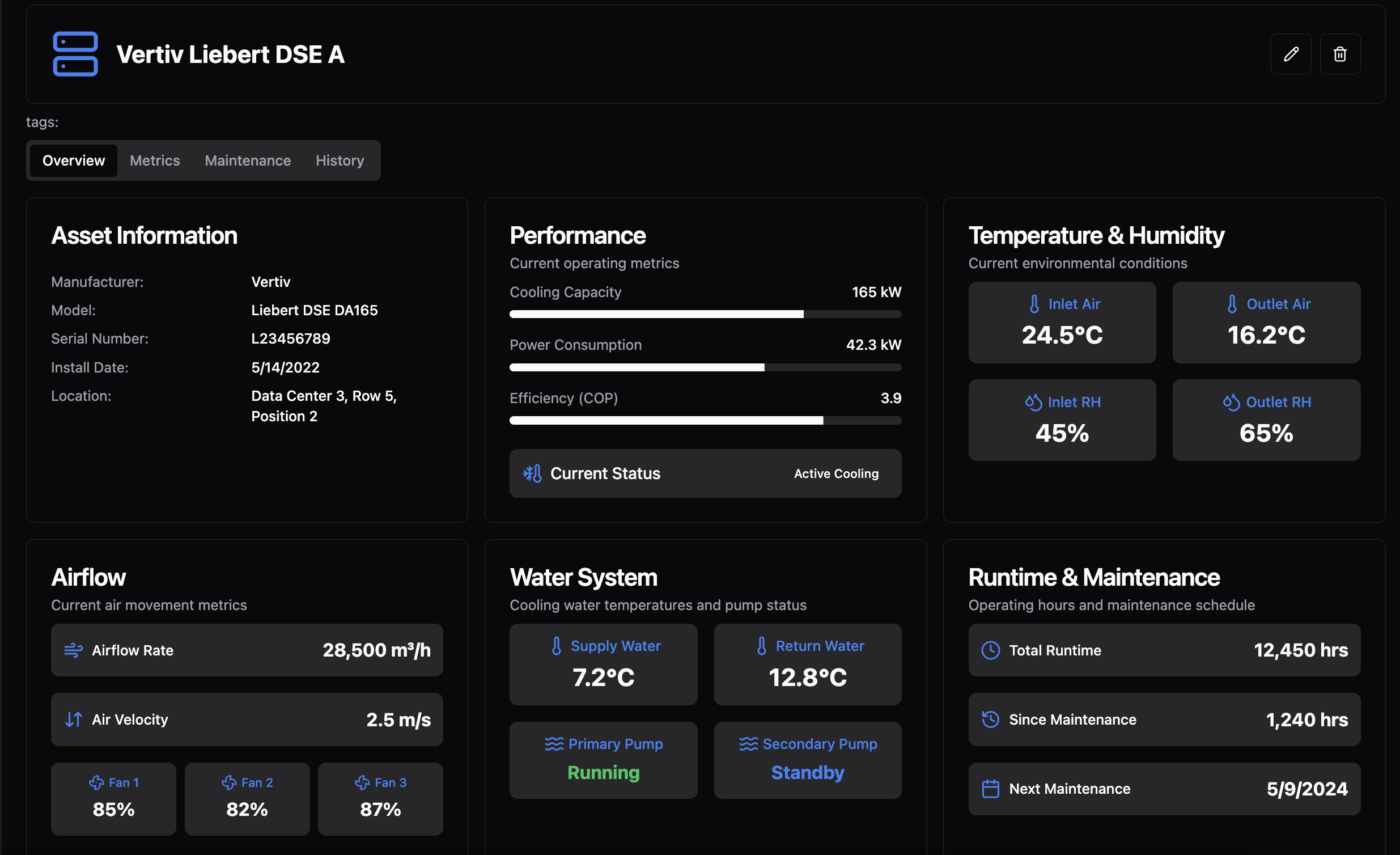
Comprehensive DCIM Features
Real-Time Asset Tracking
- Precise location tracking with rack-level visualization
- Automated change detection and movement tracking
- Asset relationship mapping with dependency visualization
- Real-time status monitoring with customizable dashboards
Synchronized Data Management
- Bi-directional integration with CMDB and ITSM platforms
- Real-time synchronization across all connected systems
- Single source of truth for all asset data
- Role-based access controls with detailed audit trails
Comprehensive Lifecycle Management
- End-to-end tracking from procurement to decommissioning
- Automated warranty and service contract management
- Predictive maintenance scheduling with failure analytics
- Intelligent refresh planning with TCO analysis
Advanced Capacity Planning
- Real-time space, power, and cooling capacity monitoring
- Predictive capacity modeling with "what-if" scenarios
- Utilization optimization with AI-driven recommendations
- Automated capacity reservation for planned deployments
Complete Asset Change History
- Comprehensive log of all asset modifications
- Detailed maintenance and service records
- Timestamped audit trail of configuration changes
- Performance history and trend analysis
Parent-Child Relationship Tracking
- Visualize upstream and downstream dependencies
- Impact analysis for changes and outages
- Automated service mapping across infrastructure layers
- Cascading alert management with root cause identification
DCIM vs CMDB: What's the Difference?
DCIM and CMDB serve different but complementary roles in data center management. The best approach is to integrate both for a complete physical and logical asset view.
| Capability | DCIM (e.g., Aravolta) | CMDB / ITSM (e.g., ServiceNow) |
|---|---|---|
| Primary Focus | Physical infrastructure: racks, power, cooling, space | Logical relationships: services, configurations, dependencies |
| Asset Discovery | Automated via SNMP, Redfish, IPMI, Modbus | Manual entry or agent-based discovery |
| Physical Location | Rack, row, room, U-position with visual floor plans | Site/building level (no rack-level detail) |
| Power & Cooling | Real-time power monitoring, cooling metrics, PUE | Not available |
| Capacity Planning | Space, power, weight, and cooling capacity with what-if models | Limited to license/contract capacity |
| Change Management | Physical move/add/change workflows | Full ITIL change management workflows |
| Integration | Feeds accurate physical data into CMDB via REST API | Receives data from DCIM and other sources |
Best practice: Use DCIM as the authoritative source for physical infrastructure data and integrate it with your CMDB to maintain accurate configuration items automatically.
Frequently Asked Questions
What is data center asset management?
Data center asset management is the practice of tracking, organizing, and maintaining every physical and virtual device in a data center throughout its lifecycle. This includes servers, network switches, PDUs, UPS units, cooling systems, and environmental sensors. Modern DCIM platforms automate this process with network discovery, real-time monitoring, and integration with ITSM tools like ServiceNow and Jira.
How does automated asset discovery work?
Automated asset discovery scans your data center network using protocols such as SNMPv3, Redfish, IPMI 2.0, Modbus/TCP, and BACnet/IP. The DCIM platform detects every connected device, extracts metadata (serial number, firmware version, model, manufacturer), classifies it by type, and maps it to its physical rack location. Aravolta completes this process in under 48 hours for facilities with 10,000+ devices.
What is the difference between DCIM and CMDB?
DCIM (Data Center Infrastructure Management) focuses on the physical layer: rack layouts, power chains, cooling, and environmental monitoring. A CMDB (Configuration Management Database), typically part of ITSM platforms like ServiceNow, tracks logical relationships between IT services and configuration items. DCIM feeds accurate physical data into the CMDB, ensuring the CMDB reflects real-world infrastructure. The two systems complement each other and should be integrated for a complete asset view.
How long does automated asset onboarding take?
With Aravolta, automated asset onboarding completes in under 48 hours for facilities with 10,000+ devices. The process includes network discovery (2-4 hours), auto-classification and monitoring template application (4-8 hours), validation and tuning (4-8 hours), and go-live (2-4 hours). Manual onboarding for the same facility typically takes weeks to months.
What devices can be automatically discovered?
Any device that supports SNMPv3, Redfish, IPMI 2.0, Modbus/TCP, or BACnet/IP can be auto-discovered. This includes servers (Dell, HP, Lenovo, Supermicro), network switches (Cisco, Arista, Juniper), PDUs (Schneider, Eaton, Raritan, ServerTech), UPS units, cooling systems (CDUs, CRAHs, in-row coolers), and environmental sensors for temperature and humidity.
Can DCIM integrate with ServiceNow and Jira?
Yes. Aravolta integrates with ServiceNow, Jira, and other ITSM platforms via REST API. Discovered assets automatically create or update CMDB configuration items, trigger provisioning and change management workflows, and maintain bi-directional synchronization as assets are added, moved, or decommissioned.
What is asset lifecycle management in a data center?
Asset lifecycle management tracks every stage of a device's life: procurement, deployment, operation, maintenance, and decommissioning. DCIM platforms automate warranty tracking, predictive maintenance scheduling, firmware management, and end-of-life planning. This reduces unplanned downtime, ensures compliance, and optimizes total cost of ownership (TCO).
How does DCIM improve capacity planning?
DCIM provides real-time visibility into space, power, and cooling utilization across your data center. It enables predictive capacity modeling with what-if scenarios, identifies stranded capacity, and provides AI-driven placement recommendations for new deployments. This prevents over-provisioning and ensures efficient use of available resources.
Last updated: March 2026