
Circuit-level power visibility. Automated billing.
Stop guessing how much power each tenant uses. Real-time branch circuit monitoring with automated invoicing that pays for itself.
What is Branch Circuit Monitoring?
Branch circuit monitoring (BCM) is the real-time measurement of electrical power at the individual circuit level in a data center. Instead of monitoring only at the main feed or PDU, BCM tracks amps, volts, watts, power factor, and kWh for each branch circuit — mapping directly to specific racks, cages, or tenants. This enables accurate per-tenant billing, proactive overload prevention, and granular capacity planning. Aravolta automates the entire workflow: polling hardware every 30 seconds, detecting overages instantly, and generating invoices without manual intervention.
Last updated: March 2026
Without Branch Circuit Monitoring
- Manual meter reads every billing cycle
- Disputes over power consumption
- Overloaded circuits cause outages
- Spreadsheets for billing reconciliation
- No visibility into tenant power abuse
With Aravolta BCM
- Automated usage tracking 24/7
- Verifiable data eliminates disputes
- Proactive alerts prevent outages
- Auto-generated invoices
- Instant overage detection
Everything you need for power management
From real-time monitoring to automated billing—all in one platform
Real-Time Metering
Track amps, volts, watts, and power factor across every circuit. High-accuracy data from all major panel board and tap box manufacturers.
Threshold Alerting
Set custom warning and critical thresholds per circuit. Get instant notifications via email, SMS, Slack, or PagerDuty before problems escalate.
Automated Billing
Generate accurate, usage-based invoices automatically. Integrate with your billing system or export directly to accounting.
Usage Analytics
Historical trends, peak usage analysis, and capacity forecasting. Know exactly who's using how much power—and when.
Tenant Self-Service Alerts
Let tenants set their own alert thresholds through the customer portal. Reduce support tickets while improving satisfaction.
30-Second Polling
Near real-time visibility with configurable polling intervals. Capture transient loads and power spikes that others miss.
How to deploy branch circuit monitoring with Aravolta
Go from zero to full circuit-level visibility in days, not months
Discover Hardware
Aravolta auto-discovers your existing metering hardware (panel boards, tap boxes, smart PDUs) via SNMP or Modbus network scan. No agents to install.
Map Circuits to Tenants
Assign each branch circuit to the corresponding tenant, cage, or rack through the Aravolta dashboard. Import existing mappings from a CSV or configure manually.
Set Thresholds & Contracts
Define each tenant's contracted power (kW), warning thresholds, critical thresholds, and overage rate schedule. Configure alert destinations (email, Slack, PagerDuty).
Monitor & Bill Automatically
Aravolta begins polling every 30 seconds immediately. Dashboards, alerts, and automated invoices are live from day one. Tenants get self-service portal access.
Never miss a power overage again
Aravolta automatically detects when tenants exceed their contracted power. Get instant alerts and generate overage invoices with one click.
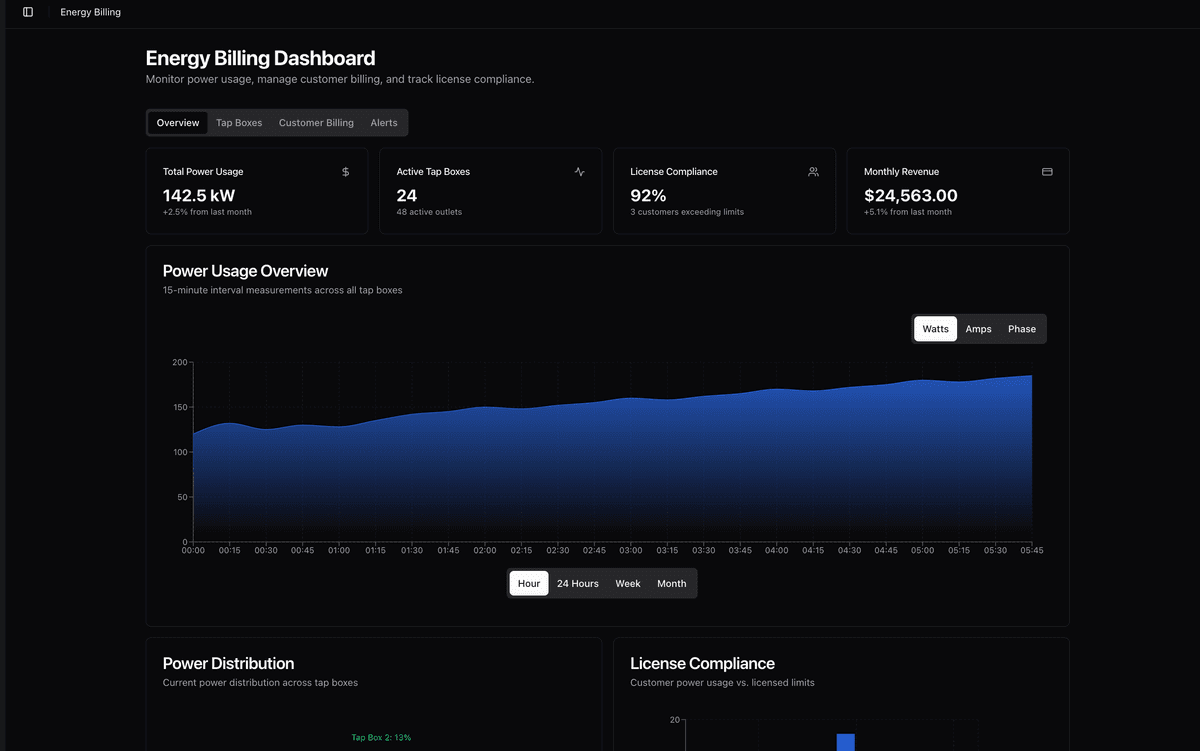
How automated overage billing is calculated
Transparent, auditable formula that eliminates billing disputes
Overage Charge Formula
Overage ($) = (Actual kW - Contracted kW) x Overage Rate ($/kW) x Billing Period
Example calculation
Aravolta calculates overage using the 95th percentile or average kW method (configurable per contract). Data is sampled every 30 seconds, aggregated per billing cycle, and fully auditable in the tenant portal. Overage invoices can be generated automatically or queued for operator review.
Works with your existing hardware
Native support for all major power monitoring vendors. No rip-and-replace required.
| Vendor | Protocol | Data Collected |
|---|---|---|
| Vertiv/Geist | SNMP v2c/v3 | Amps, Volts, Watts, kWh, Power Factor, Temperature |
| Raritan | SNMP v2c/v3 | Amps, Volts, Watts, kWh, Power Factor, VA |
| Server Technology | SNMP v2c/v3 | Amps, Volts, Watts, kWh, Power Factor |
| Eaton | SNMP / Modbus TCP | Amps, Volts, Watts, kWh, Power Factor, THD |
| Schneider Electric | Modbus TCP/RTU | Amps, Volts, Watts, kWh, Power Factor, Demand |
| Legrand | SNMP v2c/v3 | Amps, Volts, Watts, kWh, Power Factor |
| Packet Power | SNMP / REST API | Amps, Volts, Watts, kWh, Temperature, Humidity |
| Any SNMP/Modbus Device | SNMP v1/v2c/v3, Modbus TCP/RTU | Custom OID/register mapping available |
Don't see your hardware? We support any SNMP or Modbus device. Contact us
Frequently asked questions about branch circuit monitoring
Everything data center operators need to know about BCM and automated tenant billing
What is branch circuit monitoring?
Branch circuit monitoring (BCM) is the practice of measuring electrical power at the individual circuit level within a data center. Rather than monitoring power only at the main feed or PDU level, BCM tracks amps, volts, watts, power factor, and energy consumption (kWh) for each branch circuit feeding individual racks or tenant cages. This granular visibility enables accurate tenant billing, capacity planning, and early detection of overloads or anomalies.
How does automated tenant billing work?
Aravolta continuously polls your branch circuit metering hardware every 30 seconds. The platform aggregates kWh consumption per tenant over each billing cycle, compares actual usage against contracted power levels, and automatically generates usage-based invoices. If a tenant exceeds their contracted power, Aravolta flags the overage and can auto-generate a supplemental overage invoice based on your rate schedule. Invoices can be exported to your accounting system or sent directly to tenants via the self-service portal.
What hardware is compatible with Aravolta branch circuit monitoring?
Aravolta supports all major power monitoring vendors including Vertiv/Geist, Raritan, Server Technology, Eaton, Schneider Electric, Legrand, and Packet Power. The platform communicates via SNMP (v1, v2c, v3) and Modbus (TCP and RTU) protocols, which means virtually any standards-based metering device can be integrated. No proprietary hardware is required—Aravolta works with your existing infrastructure.
How does branch circuit monitoring prevent outages?
Branch circuit monitoring prevents outages by providing real-time visibility into the load on every circuit. Aravolta lets operators set custom warning and critical thresholds per circuit. When a circuit approaches its rated capacity, the platform sends instant alerts via email, SMS, Slack, or PagerDuty—giving the operations team time to redistribute loads or address the issue before a breaker trips. Historical trend analysis also helps identify circuits that are gradually approaching capacity.
What is the polling interval for Aravolta BCM?
Aravolta's default polling interval is 30 seconds, providing near real-time power data for every monitored circuit. This interval is configurable—it can be set as low as 10 seconds for environments requiring tighter monitoring or increased for larger deployments to optimize network bandwidth. The 30-second default captures transient loads and power spikes that traditional 5- or 15-minute polling intervals miss.
How does Aravolta detect power overages?
Aravolta compares each tenant's actual power consumption (measured in kW) against their contracted power allocation in real time. When actual usage exceeds the contracted level, the platform immediately flags the tenant as in overage. Operators receive instant notifications and can view all current overages on a single dashboard. Overage billing is calculated as: (Actual kW - Contracted kW) x Overage Rate ($/kW) x Duration. This can be billed monthly or on a custom schedule.
What is the difference between branch circuit monitoring and traditional power monitoring?
Traditional power monitoring typically measures power at the main electrical feed or UPS level, providing only a facility-wide aggregate view. Branch circuit monitoring goes deeper—tracking power at the individual circuit level, which maps directly to specific racks, cages, or tenants. This granularity enables per-tenant billing, circuit-level capacity planning, and pinpoint identification of where power issues originate. Traditional monitoring tells you the building is using 500 kW; BCM tells you exactly which tenant, rack, and circuit is responsible for each kilowatt.
See your power infrastructure clearly
Deploy branch circuit monitoring in your facility. Works with your existing hardware. Automated billing included.
- 30-second polling
- Auto-generated invoices
- Tenant self-service