
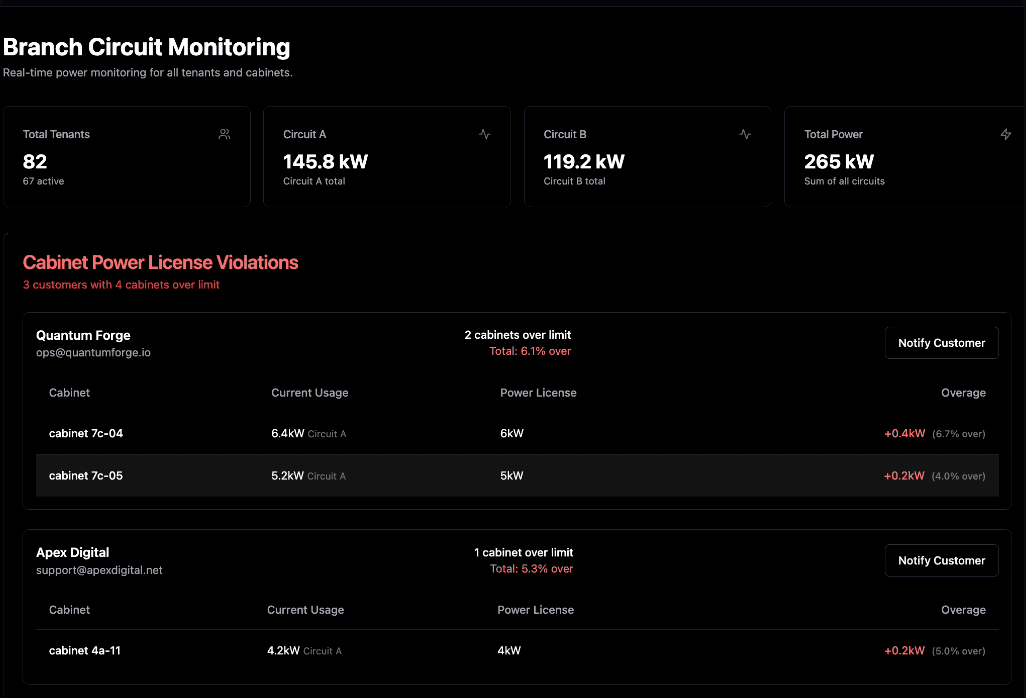
A colocation operator sells power by the circuit, so the branch circuit is where capacity problems and billing arguments both show up. Aravolta monitors at that level and uses the same readings for alerts and for invoices.
Circuit-level power visibility
Aravolta reads every branch circuit in the facility: amps, volts, watts, and power factor. You see which circuits are close to their breaker rating before they trip, and which tenants are drawing more than they are licensed for.
Current, voltage, and power per circuit
Every circuit is read at sub-second intervals
Alerts on threshold breaches
Set a warning level and a critical level. You hear about a circuit before its breaker trips.
Capacity planning from measured load
Plan the next deployment on what the circuits actually draw instead of nameplate ratings
Automated alerting for you and your customers
Tenants set their own alert thresholds in their portal. Your team gets the same alerts routed through escalation rules, so a breach at 2 AM reaches the person on call instead of a shared inbox.
A portal for each tenant
Each tenant logs in, watches their own power draw, and sets their own alerts
Thresholds for power, temperature, and other points
Warning and critical levels can differ by customer and by equipment type
Tickets in ServiceNow or Jira
An alert can open a ticket in ServiceNow, Jira, or whatever ticketing system you already run
Escalation rules
Build escalation paths in stages. Each stage can notify by SMS, email, or webhook
Metering, alerts, and reporting
Metering
- Amps, volts, watts, and power factor, logged per circuit
- Collects from the major branch circuit metering hardware
- Set a shorter polling interval on the circuits that matter most
Threshold alerts
- Warning and critical thresholds you set yourself
- Notifications by email, SMS, or Slack
- Catch an overload before one tripped breaker becomes several
Reporting
- Historical usage and trend reports
- Consumption broken out by rack, row, or customer
- The same data shows where energy is being wasted
Metered billing
Invoices come from metered usage instead of a spreadsheet, so the number a tenant sees is the number the meter recorded. Disputes drop because there is nothing to argue about.
Usage-based invoices
Aravolta totals each tenant's consumption from the circuit readings and generates the invoice from that
Connects to your billing system
The totals go to your ERP or billing platform over an API
Consumption reports for tenants
Tenants pull their own usage data and history from the portal, so they do not have to ask you for it
Frequently asked questions
What is branch circuit monitoring for colocation data centers?
Branch circuit monitoring meters every branch circuit in a data center: current, voltage, watts, and power factor, read at sub-second intervals. In a colo that is the level at which power is sold.
How does Aravolta help with billing accuracy in colocation facilities?
Aravolta totals consumption per tenant from the circuit readings and generates the invoice from that total, then passes it to your ERP or billing platform over an API. Nobody retypes meter readings.
What happens when a circuit approaches its capacity limit?
When a circuit crosses a threshold you set, Aravolta sends an alert by email, SMS, or Slack and runs it through your escalation rules, so you hear about it while the breaker is still closed.
Can colocation customers monitor their own power usage?
Yes. Each tenant gets a portal that shows only their own circuits. They set their own alert thresholds there and pull their own consumption reports and history.
How does branch circuit monitoring improve data center uptime?
An overload usually builds for a while before the breaker trips. Warning thresholds give your on-call engineer that window, and trend reports show which circuits sit close to their rating so you can rebalance ahead of time.
What types of alerts can be configured in Aravolta?
Warning and critical thresholds on power, temperature, and other monitored points. An alert can go out by SMS, email, or webhook, open a ticket in ServiceNow or Jira, and escalate in stages.
Does Aravolta support capacity planning for colocation providers?
Yes. Usage history and trends are reported by rack, row, or customer, so you plan the next deployment on measured draw rather than nameplate ratings.
Can Aravolta integrate with existing data center systems?
Yes. Alerts can open tickets in ServiceNow, Jira, and similar ITSM platforms, and billing totals go to your ERP or billing system over an API.
Last updated: March 2026
One set of readings
Everything above runs off the same circuit readings. The reading that warns your on-call engineer is the one the tenant sees in their portal and the one that goes on the invoice. When those come from separate systems, someone spends the month reconciling them.