

The largest data center ever built, housing $18 billion in GPUs, uses about 2.5x the water of a single In-N-Out and less than two average golf courses.
One burger, one data center
One comparison changed how we think about the whole topic.
xAI's Colossus 2 is the largest data center ever built: roughly 1.3 to 1.4 GW at full capacity, over 500,000 GPUs, and more electricity than the city of San Diego. A typical data center runs at 5 to 10 MW (IEA). At that size it uses about as much water as one or two holes on a golf course. Colossus is 150 times larger, and by a wide margin the most power-hungry and water-hungry computing facility on the planet. (Introl)
SemiAnalysis compared the water footprint of Colossus 2 with that of an average In-N-Out Burger location. The data center's blue water footprint comes to roughly 346 million gallons per year. The burger joint, once you count the water embedded in beef production, comes to 147 million gallons. (SemiAnalysis)
| What | Annual Water Consumption | Notes |
|---|---|---|
| Colossus 2 (largest DC ever built) | ~346 million gallons | 1.3 GW, 500K+ GPUs, more power than San Diego |
| Average 18-hole golf course | ~200 million gallons | 150 acres of maintained turf |
| One In-N-Out location | ~147 million gallons | Including water embedded in beef production |
| Average U.S. household | ~120,000 gallons | ~329 gallons/day |
Sources: SemiAnalysis · Introl · IEA · USGA · EPA
That does not make water a non-issue. The IEA puts a 100 MW facility at roughly 530,000 gallons of water per day once you count both direct cooling and the indirect water used to generate its electricity (IEA). Scale that to 1 GW and you are using water at the rate of roughly 26,000 households. In Arizona, Texas, and parts of Northern Virginia, where water is already short, that is a real cost to the people who live there.
But compare compute per gallon against industries nobody thinks twice about and the picture changes. Data centers start to look less like the villain and more like one of the more resource-efficient sectors in the economy.
There is also a tradeoff most reporting misses. PUE and WUE (power and water usage effectiveness) pull against each other. Many facilities get their low PUE by using evaporative cooling, which trades electricity overhead for water. You cut your energy waste by evaporating hundreds of thousands of gallons a day. So when a facility brags about a PUE of 1.2, ask what its WUE looks like. Often the answer is uncomfortable.
The water story is also getting better, fast, and not because of environmental pressure. Physics is doing it. You cannot air-cool an H100 at 700W in a dense rack at a reasonable cost, so the thermal load of AI accelerators is pushing the whole industry to liquid cooling. Direct liquid cooling and immersion systems reject heat through dry coolers and consume close to no water, and liquid moves heat 50 to 1,000 times more efficiently than air (Lawrence Berkeley National Lab). New AI builds specify liquid cooling from day one. xAI is building a recycling plant to cool Colossus 2 with recycled municipal wastewater, which would make it close to a net-zero water facility.
The environmental benefit is a side effect of the thermal math.
Do data centers pollute water?
Mostly, no. The distinction matters, because “pollute” and “consume” get conflated in nearly every headline. Data centers do not use water the way a factory uses process chemicals. Cooling water goes one of three ways: it evaporates (cooling towers), it circulates in a sealed loop and never leaves, or it goes back to the source or the sewer under a discharge permit.
The discharge streams that do exist are narrow and regulated. In the US, anything a facility returns to a waterway falls under Clean Water Act permitting, which caps how warm the returned water can be. Cooling-tower blowdown (the periodic flush that keeps minerals from concentrating in the loop) carries dissolved solids and treatment chemicals, and it goes to municipal wastewater treatment under permit, the same path as the HVAC water from any large office building. None of it looks like the untreated-outfall picture the question usually has in mind.
The fair critique is the one above: consumption, not contamination. Evaporated water is gone from the local basin until it rains again, and where water is scarce that is a real cost to the community even though nothing was polluted. It is also why the liquid-cooling shift counts twice. Closed-loop and immersion systems neither evaporate much water nor discharge it, and new builds like Colossus 2 are pairing them with recycled municipal wastewater instead of potable supply.

In Finland, data center waste heat will supply 40% of district heating for 250,000 people.
Heating a quarter million people with server exhaust
Every watt a data center draws ends up as heat, and most facilities vent it to the atmosphere. That is starting to change, at a scale most people have not noticed.
Microsoft and the utility Fortum are building one of the largest waste heat recovery systems in the world in Finland. Data center heat will supply roughly 40% of district heating for 250,000 people across Espoo, Kauniainen, and Kirkkonummi, going live this year. That is one campus heating a quarter million people with energy that would otherwise be dumped to the air. (Microsoft)
It is not a one-off. In Denmark, a data center gives its waste heat away free to nearly 11,000 homes. In Paris, the Equinix PA10 facility captures enough server heat to warm 1,000 homes or keep the Olympic Aquatics Centre's pools at temperature. Amazon's Tallaght project in Ireland saved 1,100 tonnes of CO₂ in its first year (Amazon). A 100 MW facility gives off roughly 100 MW of heat, and the equipment to capture it is mature. The barrier has been proximity to someone who wants the heat, and that is changing as more facilities get sited and built with heat recovery in the design from the start.
In northern Europe, heating buildings takes roughly 40% of total energy use, so server heat fed into district loops is a meaningful dent in the whole energy picture. Germany's new Energy Efficiency Act requires new data centers to use at least 10% of their waste heat from July 2026, rising to 20% by 2028 (Germany EnEfG). Regulation is catching up with what the economics already support.
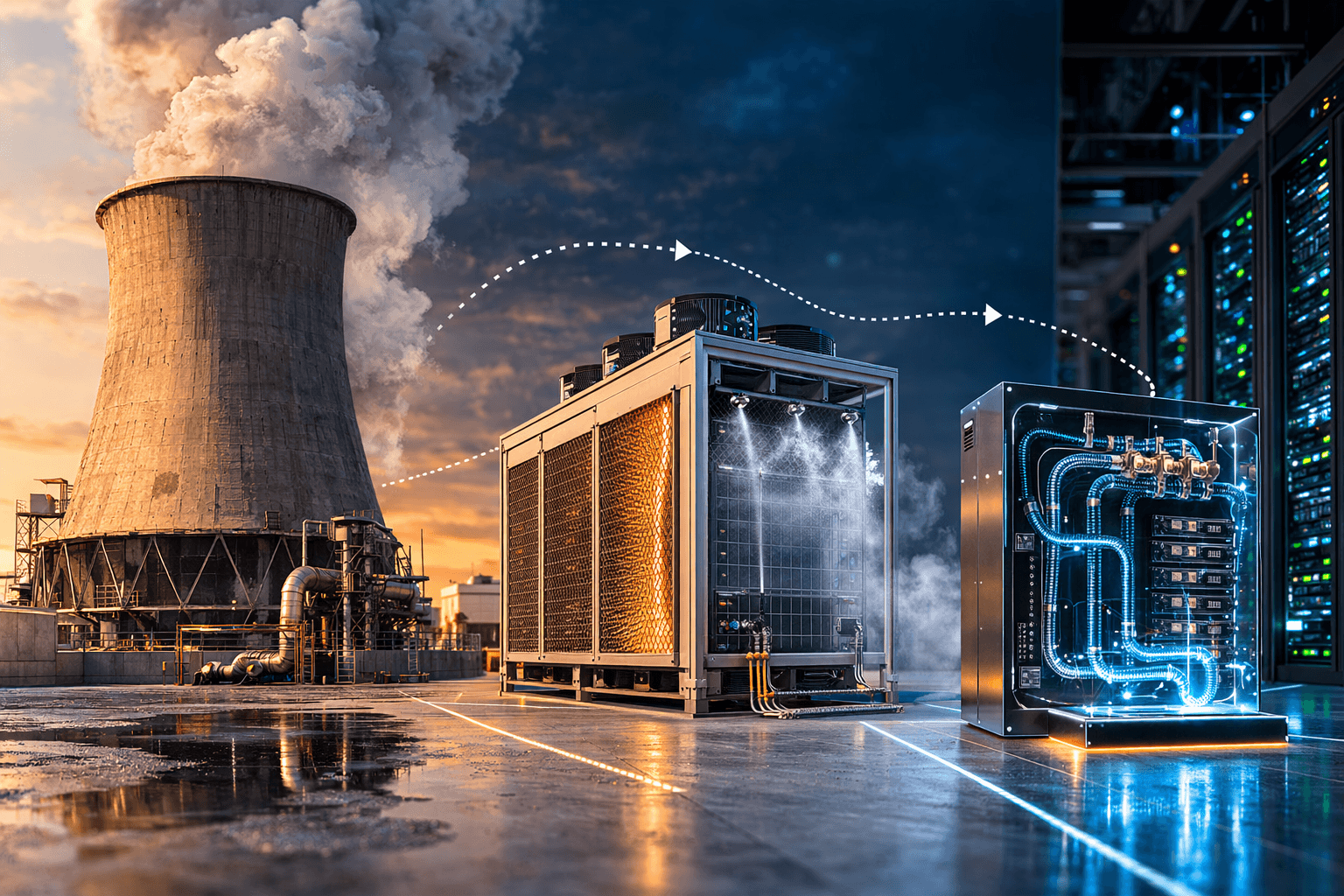
The shift from air to liquid cooling cuts water use and energy overhead at the same time.
Getting more efficient, fast
Global data center electricity consumption hit roughly 415 TWh in 2024 (IEA), about 1.5% of global demand. That sounds alarming until you put it next to the rest of the ledger:
| Sector | % of Global Electricity | What It Does |
|---|---|---|
| Industrial processes | ~42% | Manufacturing, mining, refining |
| Commercial buildings | ~18% | Offices, retail, restaurants |
| Air conditioning | ~10% | Cooling buildings globally |
| Data centers | ~1.5% | Commerce, healthcare, finance, AI, communications |
| Bitcoin mining | ~0.6% | One asset class |
Sources: IEA · IEA: Future of Cooling · Congressional Research Service
Nearly all of modern commerce, communication, healthcare, finance, and logistics runs on data centers. For 1.5% of the grid, you get a lot of civilization.
And that 1.5% buys more compute every year.
PUE keeps dropping. A decade ago a PUE of 2.0 was common. Today the industry average is 1.56 (Uptime Institute), and the best facilities run at 1.1 or below. Google reports a fleet-wide PUE of 1.09 (Google). Every reduction in PUE means less energy spent on cooling, lighting, and power distribution for each watt of compute delivered, and the curve has not flattened yet.
Chips are getting better too. Each generation of GPU and accelerator delivers more compute per watt than the last. Power density is going up, which sounds bad, but it means a workload that took a full rack five years ago runs on a fraction of the hardware today, so the energy per unit of useful output falls even as the absolute numbers keep climbing.
And as covered above, liquid cooling improves PUE at the same time as it removes water consumption. Air handling is the biggest piece of overhead energy in most facilities. Replace it with direct liquid cooling and the water use and the energy overhead go down together. The old tradeoff between PUE and WUE is dissolving, and the next generation of facilities will use less of both per compute watt.

Every digital transaction replaces a physical process with its own, often larger, footprint.
What the compute displaces
This is the part of the environmental ledger that almost never gets counted.
The 415 TWh does not exist in a vacuum. It replaces physical processes with their own, often much larger, energy and carbon footprints. Remote work, which runs entirely on data centers, saves an average of 3.6 tons of CO₂ per worker per year, a 58% cut in work-related emissions (Stanford/PNAS). Multiply that across tens of millions of remote and hybrid workers and the total gets large fast. Telehealth visits replace hospital trips, and digital logistics take empty miles off trucks. AI-tuned agriculture cuts fertilizer waste, and streaming a movie uses a fraction of the energy that went into making, shipping, and disposing of a disc.
A more concrete example: the U.S. banking system runs roughly 72,000 branches, each with lighting, HVAC, paper handling, physical security, and the traffic of staff and customers driving to it. Every transaction that moves online, every check deposited by phone, every wire sent from a laptop, takes a sliver off that footprint. The same logic applies to retail (a warehouse serving e-commerce uses far less energy per transaction than millions of storefronts), to media, to education, to government services. Data centers did not conjure demand out of nothing. They absorbed demand that used to need buildings, vehicles, paper, and fuel.
BCG estimated AI applications could cut global emissions by 5 to 10% by 2030, or 2.6 to 5.3 billion metric tons annually (Scientific American). The precision of that estimate is debatable. That the displacement effect exists is not, and if it is even a fraction of the estimate it dwarfs the 415 TWh spent to make it happen.
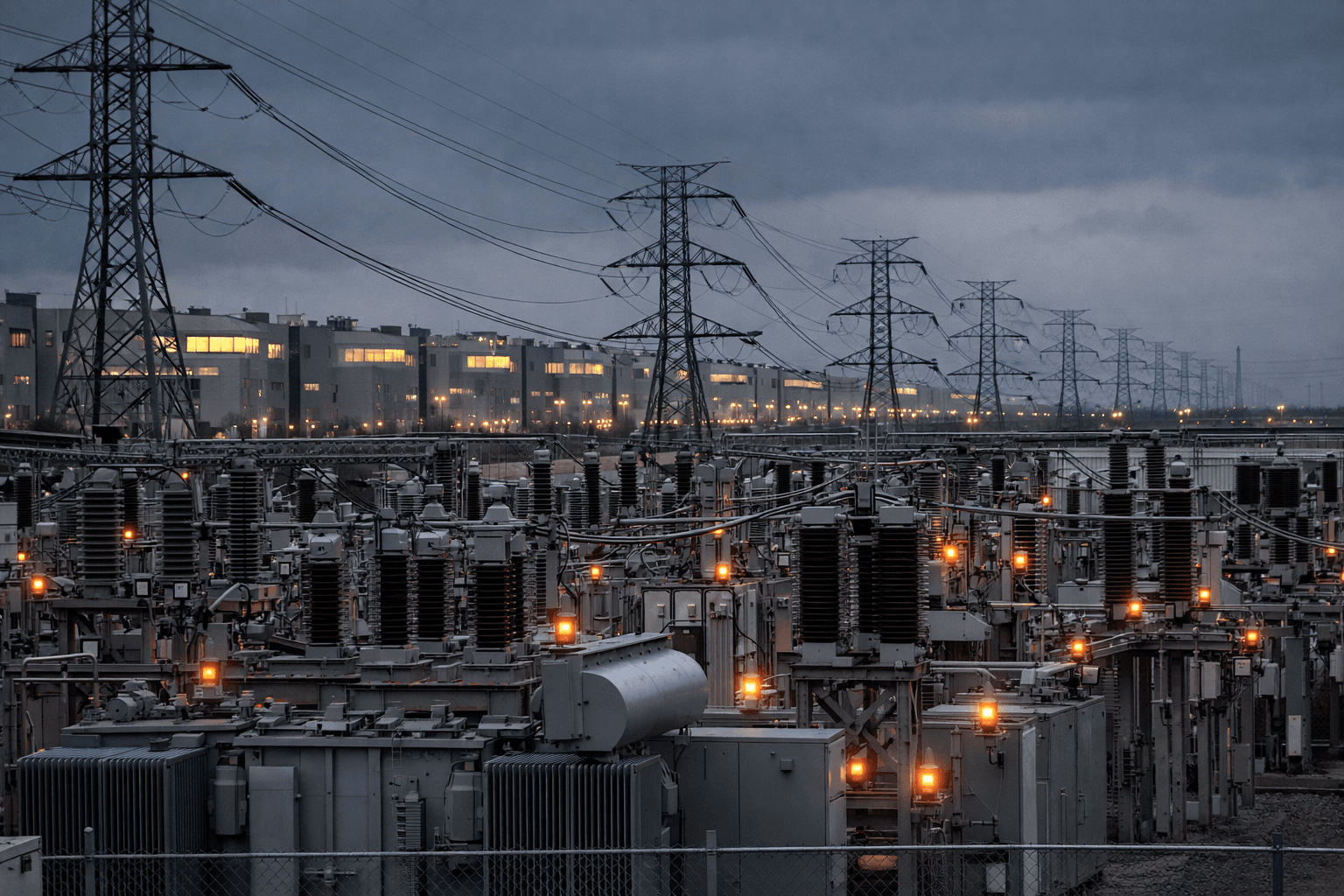
Data center electricity consumption is projected to more than double by 2030.
Now for the honest part
Data centers are adding a large new load to a grid that was already struggling, and there is no way to spin that.
The 415 TWh from 2024 is projected to more than double by 2030 (Gartner). And it is landing on a grid that is already full. In Northern Virginia, the densest data center market on Earth, Dominion Energy has warned that new connections could wait years. ERCOT in Texas is working out how to take tens of gigawatts of new data center load without putting residential reliability at risk. PJM, which runs the grid for 13 eastern states, has more than 260 GW sitting in its interconnection queue, most of it tied to data centers.
The U.S. grid was not built for this. For decades, electricity demand was roughly flat. Now it is climbing, and data centers are a big part of why.
There is also a carbon accounting problem worth calling out. Microsoft's sustainability report showed total emissions up 23.4% since 2020 (Microsoft). Location-based Scope 2 more than doubled, from 4.3 million to nearly 10 million metric tons of CO₂. Google's hit 11.5 million metric tons, up roughly 50% in five years (Google). Google then managed to report a 12% decrease in data center emissions while disclosing a 27% increase in electricity consumption. That math works on paper (renewable energy certificates and power purchase agreements) but not in physics. A REC is a piece of paper. You buy one from a wind farm in Oklahoma and claim it offsets your coal-fed facility in Virginia. The electrons do not care about your accounting.
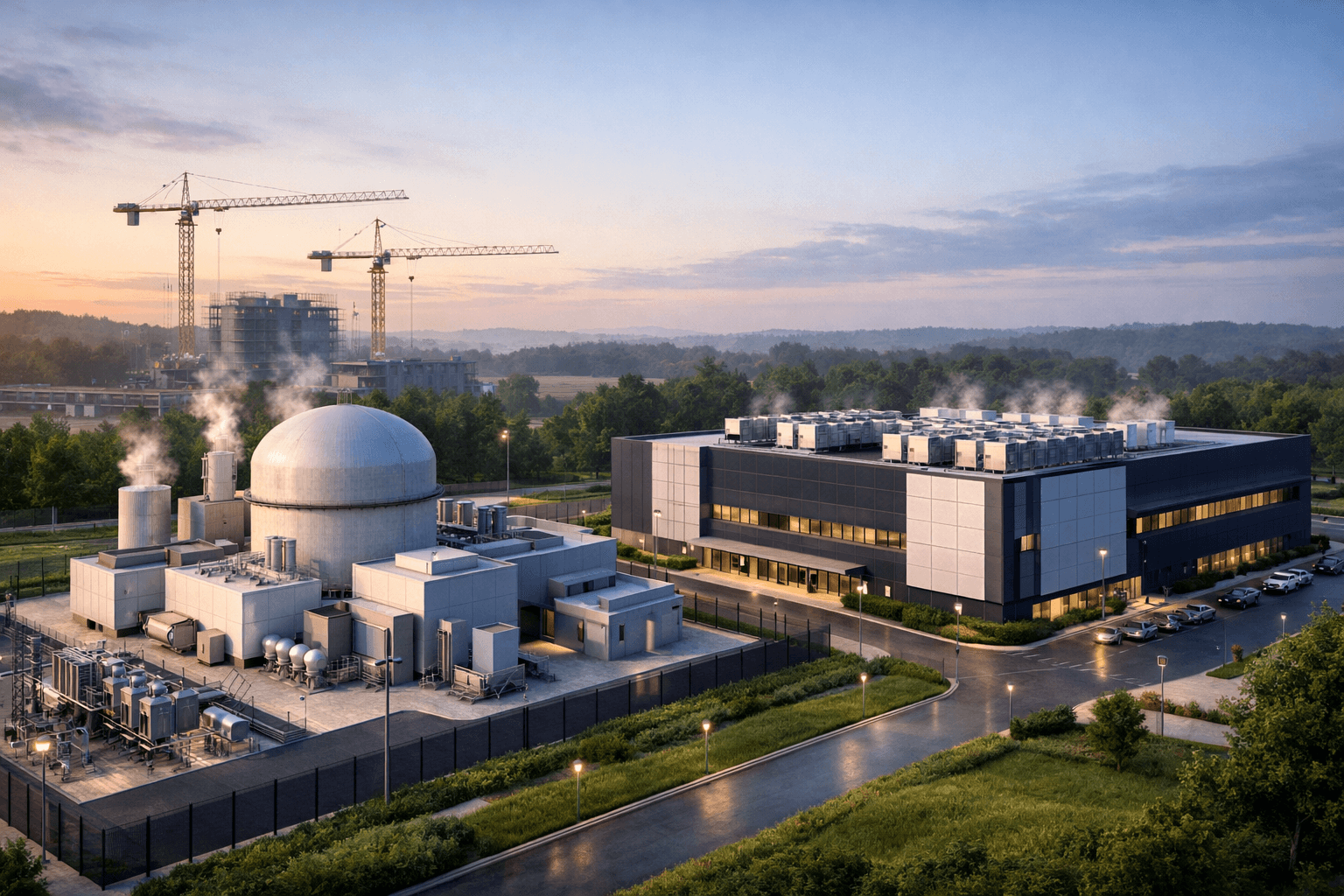
Tech companies have committed to over 25 GW of nuclear capacity, more than a quarter of America's existing fleet.
What happens next: 25 gigawatts of nuclear and a grid getting rebuilt
The companies stressing the grid are also the ones writing the biggest checks to upgrade it.
Microsoft signed a 20-year deal to restart Three Mile Island's 835 MW reactor (DCD). Constellation Energy is putting $1.6 billion into the restart. Google signed the first U.S. corporate SMR fleet deal with Kairos Power for 500 MW (DOE). Amazon locked in 1.9 GW of nuclear capacity through 2042, and Meta signed for over 2.1 GW. Together, big tech has committed to over 25 GW of data center-linked nuclear capacity. For proportion: the entire U.S. nuclear fleet, 94 reactors built over decades, totals 97 GW. Tech companies are financing the equivalent of over a quarter of America's existing nuclear capacity. No other private industry has come close.
| Company | Capacity | Type | Timeline |
|---|---|---|---|
| Microsoft | 835 MW | Three Mile Island restart (Constellation) | 20-year PPA |
| 500 MW | SMR fleet (Kairos Power) | First U.S. corporate SMR deal | |
| Amazon | 1.9 GW | Nuclear portfolio | Through 2042 |
| Meta | 2.1+ GW | Nuclear portfolio | Multiple deals |
| Combined big tech | 25+ GW | Nuclear + SMR | Various |
| U.S. nuclear fleet (all 94 reactors) | 97 GW | Reference | Built over decades |
These are not certificates. These are physical plants being built or restarted because a creditworthy buyer showed up with a 20-year contract. Nuclear had been stuck for decades: most people agreed it was the best route to clean baseload, and nobody could finance it, because the capital risk was too high, the permitting too slow, and the political will too thin. Data center operators broke the logjam. They are the first customer with the scale, the credit quality, and the demand certainty to make a nuclear investment bankable. Without that demand, Three Mile Island stays shut and SMRs stay in pilot.
Geothermal is moving too. In 2025 alone, tech companies signed 14 geothermal PPAs totaling 635 MW, triple the 2024 volume. Fervo Energy closed a $462 million Series E to build enhanced geothermal in Utah (Fervo). Google signed a 150 MW deal with Ormat (Google). Enhanced geothermal runs around the clock with near-zero emissions and a small land footprint, and a whole category of clean generation is being pulled into commercial viability because data centers need power and will pay for it.
Data centers are also well placed to soak up stranded renewable energy. An estimated 30 to 40% of renewable generation goes unused (Soluna/DCK). The reasons are transmission bottlenecks, thin local demand, and no storage. Wind farms curtail. Solar makes power nobody takes. This may be the central unsolved problem of the energy transition: we can build renewables faster than we can use what they generate.
Compute, unlike most manufacturing, is interruptible. You can pause a training run or push a batch job to later. An aluminum smelter cannot shed load without destroying product. A data center can shed or absorb hundreds of megawatts in minutes.
This already happens. Google runs demand response with utilities including Indiana Michigan Power, the Tennessee Valley Authority, and Omaha Public Power District. When a grid event is called, Google gets advance notice and its scheduler issues hour-by-hour instructions to specific sites to defer non-urgent compute, machine learning jobs included, either running it after the event or moving it to data centers on other grids. The data center works, in effect, like a large battery the grid can call on. (Google Cloud)
Soluna built its whole model on siting next to renewable plants and burning power that would otherwise be curtailed. UChicago's "Zero-Carbon Cloud" research found excess renewable supply available roughly 80% of the time, enough to run delay-tolerant workloads almost entirely on energy that was going to waste (UChicago). Duke research found that moving compute to wherever clean power is in surplus cuts solar curtailment by up to 61%.
The grid is under stress, but it is also getting rebuilt, and the companies doing the stressing are writing the checks.
Seven major tech companies signed the White House Ratepayer Protection Pledge in March 2026.
Making them pay their fair share
Private investment is necessary but not sufficient. Government is starting to make sure data center growth does not land on everyone else's bill. This is the piece that matters most.
On March 5, 2026, Amazon, Google, Meta, Microsoft, OpenAI, Oracle, and xAI signed the White House "Ratepayer Protection Pledge" (White House). The commitments are specific: pay the full cost of all new generation their data centers require, fund all grid upgrades, negotiate separate utility rate structures, and make backup generation available to communities during grid emergencies. The headline guarantee: residential electricity prices will not increase because of data center buildout.
These companies are volunteering to be the grid's anchor tenant and to absorb infrastructure costs that would otherwise be spread across every ratepayer. We cannot think of another industry that has made a comparable commitment.
Germany is pushing from the other direction with its Energy Efficiency Act: mandatory waste heat use, PUE thresholds, and public reporting of energy performance. The EU is moving toward similar rules. Governments are drawing lines around what operators owe the communities and grids they depend on, and so far the industry is meeting those lines rather than fighting them.
That is what turns private investment into public benefit. Left alone, companies optimize for their own bottom line. With the right policy, the same money that serves their own demand also upgrades the grid, builds clean generation, and keeps residential rates flat. Whether the pledge holds, and whether similar rules spread to other countries, will decide a lot about how this ends.

Whether data centers end up a net positive or a net negative for the environment is still open.
The next five years decide it
Where things stand: data centers are putting real strain on real infrastructure. They use a lot of electricity and water, and location-based carbon emissions are climbing at every major operator whatever the market-based reports say.
On the other side of the ledger: 25 GW of nuclear being financed, 635 MW of geothermal signed in a single year, a quarter million people about to be heated with waste heat, a cooling trajectory headed toward near-zero water, order-of-magnitude efficiency gains from workload consolidation, and signed commitments to cover the full cost of grid impact.
Whether data centers end up a net positive or a net negative for the environment is still open, and it comes down to policy and energy buildout. Do the nuclear plants get built? Does liquid cooling outrun new evaporative deployments in dry regions? Do governments keep pushing operators to pay their full cost? Do the pledges hold, and spread? The inputs are there. The outcome is not guaranteed.
Our view is that data centers will come out a net positive, and not because the industry is virtuous. It is because they are acting as a forcing function. They create demand for clean energy at a scale that justifies investment no other buyer could underwrite. They are pulling nuclear out of regulatory limbo and making geothermal commercially viable for the first time, and they give grid operators the economic case to build transmission and generation that everyone else uses too.
The grid is going to get built out, and it is going to get greener, and a good share of the reason will be that data center demand forced the issue. That forcing function, messy as it is, leaves everyone with better energy infrastructure. Nobody planned it that way. The economics and the physics do not leave another path.
Want live power and efficiency numbers from your facility?
Aravolta's DCIM platform collects the power telemetry across your fleet, so you can track consumption, work out PUE from measured numbers, and put real data behind sustainability reporting.
Sources
Water consumption & cooling
- SemiAnalysis: From Tokens to Burgers. Water footprint comparison, 346M gallons/year, 668-year burger equivalency
- Introl: xAI Colossus 2 Gigawatt Expansion. 555,000 GPUs, city-scale power comparisons
- EESI: Data Centers and Water Consumption
- IEA: Energy and AI. 530,000 gallons/day per 100 MW (direct + indirect water)
- Lawrence Berkeley National Lab: Liquid Cooling. 50 to 1,000x efficiency vs air
- Vertiv: Liquid and Immersion Cooling Options
- SiliconAngle: xAI Will Spend $18B+ on NVIDIA Chips for Colossus 2
Waste heat recovery
- Microsoft/Fortum Finland District Heating. 40% of heating for 250,000 people
- Amazon: Tallaght Waste Heat Project. 1,100 tonnes CO₂ saved in year one
- Germany Energy Efficiency Act (EnEfG). 10% waste heat mandate (July 2026), 20% by 2028
Power consumption & efficiency
- IEA: Energy Demand from AI. 415 TWh baseline, 945 TWh 2030 projection
- IEA: The Future of Cooling. Air conditioning at ~10% of global electricity
- Gartner: Electricity Demand for Data Centers to Double by 2030
- Uptime Institute: Global Data Center Survey 2024. Industry PUE of 1.56
- Congressional Research Service: Data Centers and Their Energy Consumption
- Google Data Centers: Efficiency. Fleet-wide PUE of 1.09
Carbon emissions & sustainability reports
- Microsoft Environmental Sustainability Report 2025. 23.4% emissions increase, Scope 2 doubling
- Google Environmental Report 2025. 11.5M metric tons, 12% decrease vs 27% consumption increase
- IEEE Spectrum: Data Center Sustainability Metrics. Market-based vs location-based accounting
Nuclear & geothermal
- DCD: Three Mile Island Nuclear PPA. 835 MW, $1.6B investment
- Kairos Power: Google SMR Deal. First U.S. corporate SMR agreement, 500 MW
- EIA: U.S. Nuclear Fleet Capacity. 94 reactors, 97 GW total
- Fervo Energy: $462M Series E for Enhanced Geothermal in Utah
- Google: 150 MW Ormat Geothermal Deal
Grid flexibility & demand response
- Google Cloud: Using Demand Response to Reduce Data Center Power Consumption
- Google: Making Data Centers More Flexible to Benefit Power Grids
- UChicago: Zero-Carbon Cloud. 80% renewable availability finding
- Yale Clean Energy Forum: From Grid Strain to Grid Gain
- Soluna: Stranded Renewables and AI Data Centers. 30 to 40% curtailment estimate
- Inside Climate News: Stranded Renewable Energy and Data Centers
Policy & ratepayer protection
- White House: Ratepayer Protection Pledge. Full text
- White House Fact Sheet: Ratepayer Protection Pledge Details
- The Hill: Trump Signs Agreement with Big Tech
Displacement effects
Frequently asked questions
Q: How much water do data centers actually use?
The IEA puts a 100 MW facility at roughly 530,000 gallons of water per day, counting both direct cooling and the indirect water used to generate its electricity. Proportion matters, though. xAI Colossus 2, the largest data center ever built at 1.3 to 1.4 GW and over 500,000 GPUs, uses about 346 million gallons a year. An average In-N-Out Burger location, once you count the water embedded in beef production, uses 147 million. The largest computing facility on Earth uses about 2.5 times the water of one fast food restaurant.
Q: Do data centers pollute water?
Mostly no. Cooling water either evaporates, circulates in a sealed closed loop, or goes back to the source under a discharge permit that caps its temperature. Cooling-tower blowdown goes to municipal wastewater treatment, the same as the HVAC water from any large building. The fair concern is consumption rather than contamination: evaporative cooling takes water out of the local basin, which matters where water is scarce. Newer liquid-cooled builds largely remove both issues, and some, like Colossus 2, will run on recycled municipal wastewater.
Q: Are data centers bad for the environment?
It depends on the timeframe. Right now they use about 1.5% of global electricity and are adding a large load to a grid that was already strained. They are also financing 25 GW of nuclear, pulling geothermal into commercial viability, heating a quarter million people with waste heat, and driving the largest private investment in grid infrastructure in a generation. Whether the net is positive or negative depends on policy and energy buildout over the next five years.
Q: How much nuclear power are tech companies building for data centers?
Over 25 GW between them. Microsoft signed a 20-year deal to restart Three Mile Island (835 MW). Google signed the first U.S. corporate SMR deal with Kairos Power (500 MW). Amazon locked in 1.9 GW through 2042, and Meta signed for over 2.1 GW. For scale, the entire U.S. nuclear fleet is 97 GW.
Q: Are data centers stressing the power grid?
Yes. Consumption hit roughly 415 TWh in 2024 and is projected to more than double by 2030, and in markets like Northern Virginia capacity is already short. The same operators are also paying for grid upgrades and new generation at a scale no other private industry has matched. In March 2026, seven major tech companies signed the White House Ratepayer Protection Pledge, committing to pay the full cost of the new generation and grid upgrades their facilities require.
Q: Can data center waste heat be reused?
Yes, at scale. Microsoft and Fortum are building a system in Finland where data center heat will supply roughly 40% of district heating for 250,000 people. In Denmark, a data center heats nearly 11,000 homes. Amazon saved 1,100 tonnes of CO₂ in the first year of its Tallaght project in Ireland. Germany now requires new data centers to use at least 10% of their waste heat from July 2026, rising to 20% by 2028.
Q: Will data centers be good or bad for the environment long term?
It hinges on the next five years of policy and energy investment. Data centers are acting as a forcing function for grid modernization and clean energy financing at a scale no other industry has matched. If the nuclear plants get built, if liquid cooling replaces evaporative systems, and if policy keeps pushing operators to pay their full cost, they could end up accelerating the whole energy transition. The outcome is still open.
Last updated: March 2026