

Nlyte
Aravolta
The short version
Nlyte is a DCIM built around asset management and capacity planning. Aravolta covers BMS, EPMS, SCADA, NOC, and DCIM in one platform, discovers your equipment on its own, and is running in days. If you run a colocation facility and want those functions in one system instead of a system per vendor, that is what Aravolta was built for.
Nlyte has been in the DCIM market for a long time. A colocation operator needs more than a database of equipment, though. Power metering, cooling, supervisory control, 24/7 monitoring, and tenant billing have to work together, and that is where the two platforms differ.
| Category | Aravolta | Nlyte |
|---|---|---|
| What it is | Unified BMS + EPMS + SCADA + NOC + DCIM | DCIM (asset management and capacity planning) |
| Deployment time | Days to weeks with auto-discovery | Months to years with professional services |
| Monitoring latency | Sub-second, real-time streaming | 5 to 15 minute polling intervals |
| BMS / cooling | Built-in: chillers, CRACs, sensors, fire suppression | Not included, requires separate BMS vendor |
| EPMS / power metering | Built-in: one-line diagrams, branch circuit monitoring | Basic power tracking, no one-line diagrams |
| SCADA | Web-native, any browser, no dedicated hardware | Not included |
| NOC operations | Built-in 24/7 monitoring, alerting, dispatch | Not included, requires outsourced NOC |
| Tenant billing | Automated, usage-based invoices via API | Not included |
| Customer portal | White-label, tenant self-service | Not included |
| Asset discovery | Automated via SNMPv3, Redfish, IPMI, BACnet, Modbus | Manual entry with limited auto-discovery |
| Protocols | SNMPv3, Redfish, IPMI, Modbus/TCP, BACnet/IP, gNMI, OPC-UA | SNMP, limited Modbus |
| API | REST API, webhooks | SOAP-based API |
| Pricing | Per-device, transparent | Quote-based, plus professional services |
As of March 2026. Based on publicly available documentation.
The core difference: DCIM vs. unified platform
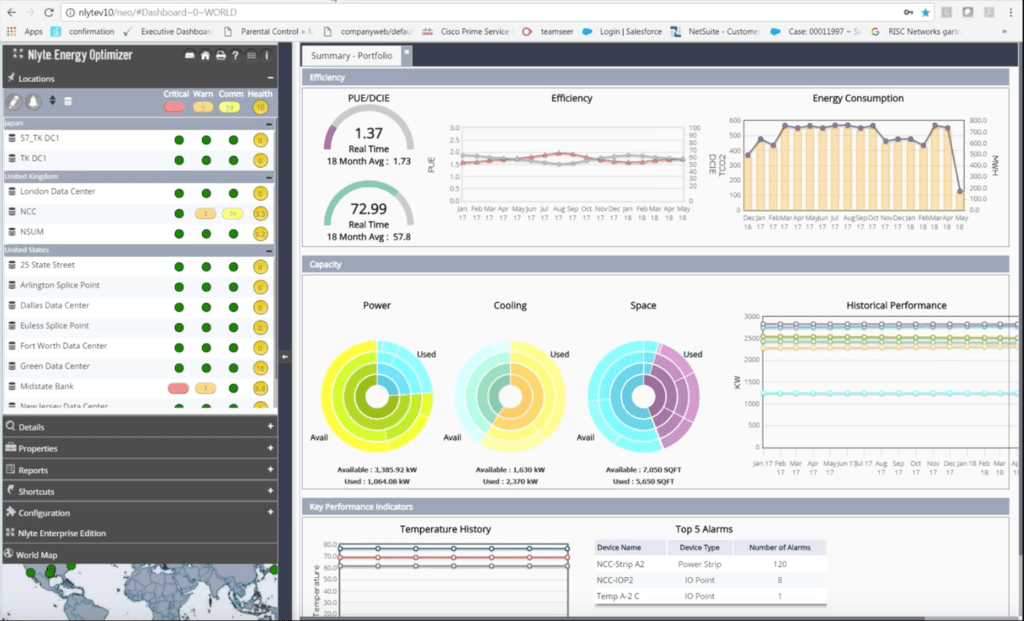
Nlyte is a DCIM. It tracks assets, manages capacity, and helps you plan where to put things.
Asset management is one piece of running a colocation facility. You also need power metering (EPMS), cooling and environmental monitoring (BMS), supervisory control (SCADA), 24/7 alerting and dispatch (NOC), and something tenant-facing for billing and self-service. With Nlyte, each of those comes from a different vendor, and getting them to talk to each other is your project.
Aravolta puts all of those in one platform. Your ops team gets one login and one vendor to call when something breaks, and the power, cooling, asset, and tenant billing data all live in the same system.
Deployment
Nlyte deployments run through professional services and take months to years. Someone enters the assets by hand, configures monitoring, builds the integrations to your BMS and power systems, and trains your team on the interface. If you run several sites, you do it again at each one.
Aravolta ships a node to your facility. You plug it into the network and it finds every IP-enabled device it can reach: PDUs, UPS systems, chillers, switches, sensors. It classifies them, maps them to racks and rows, and monitoring starts. Most facilities are running within days.
Monitoring
Nlyte polls devices every 5 to 15 minutes. That is fine for capacity planning reports, but the number on the screen is already several minutes old. If a breaker trips or a chiller goes down, you might not know for 15 minutes.
Aravolta streams metrics with sub-second updates, and alerts fire as soon as a threshold is crossed. For an operator with SLA commitments to tenants, the difference between 15 minutes and one second of detection time matters.
Tenant billing and customer portals
This is the biggest gap for a colo operator. Nlyte does not do tenant billing. You would need a separate metering system, a way to reconcile the usage data, and a manual process to turn it into invoices.
Aravolta reads every branch circuit and maps the consumption to the tenant on it. Overages are flagged automatically and invoices can be generated through the API. Tenants get a white-label portal where they can see their own usage, set their own alerts, and open support tickets without calling your team.
Cost and time to value
Nlyte is expensive. Licensing is quote-based and opaque, and that is before the professional services bill. Deployments routinely take months. For a large enterprise, onboarding can run past a year while teams enter assets by hand, integrate the separate BMS and power vendors, and go through rounds of professional services engagements.
Aravolta prices per device, and you know the number up front. It does not require professional services: the discovery engine does the work you would otherwise pay consultants for, which is entering thousands of assets into a database by hand. Most facilities go from node install to production monitoring in under 48 hours.
Switching from Nlyte
If you are evaluating a move off Nlyte, Aravolta can run next to it during the transition. The discovery engine picks up your existing equipment without anyone re-entering it.
- No manual data migration for monitored devices
- Both systems run in parallel while you evaluate
- Your team works directly with Aravolta engineers during onboarding
FAQ
Can Aravolta replace Nlyte and my BMS vendor?
Yes. Aravolta covers the BMS side (chillers, CRAC units, environmental sensors, fire suppression) as well as DCIM, and it talks to your existing BACnet, Modbus, and SNMP devices directly.
Does Aravolta work with the equipment I already have?
Aravolta is not tied to a manufacturer. It speaks SNMPv3, Redfish, IPMI, Modbus/TCP, BACnet/IP, gNMI, and OPC-UA, and it works with equipment from Schneider, Vertiv, Eaton, Honeywell, Siemens, and others.
How long does deployment actually take?
Most facilities are running within 48 hours of the node being plugged in. Discovery identifies and classifies the devices; your team checks the results and sets alert thresholds with help from our engineers.
What does tenant billing look like?
Aravolta reads power at the branch circuit level and maps consumption on each circuit to a tenant. Overages are flagged automatically. You can generate usage-based invoices through the API, and tenants can see their own data in a white-label portal.
Do I need to rip out my existing systems?
No. Aravolta runs alongside what you have and pulls data from your current BMS, power meters, and network devices. Many operators run it in parallel for a while before they switch over.
Last updated March 2026