
How USD.AI verifies GPU-backed credit positions with real-time infrastructure data
USD.AI uses Aravolta for continuous, infrastructure-level verification of GPU-backed credit positions. Live data from the servers and GPUs confirms the collateral is there, running, and accounted for. Customer workloads and tenant data are never collected.
Aravolta enables us to offer smarter, more agile financing solutions. They bridged the gap between our risk requirements and the technical reality of the data center, allowing for collateral auditing without creating operational friction for our infrastructure partners.

Co-Founder & COO, USD.AI
The challenge
Paperwork alone can't verify a GPU
GPU-backed credit uses a new kind of collateral: expensive physical compute hardware. A GPU's value as collateral depends on whether it is:
- Installed as described
- Operational over time
- Continuously accounted for
USD.AI's rule for GPU-backed credit is short: Verify, don't trust. That takes live data from the infrastructure itself, rather than periodic reports or self-attestation.
Before and after
From quarterly reports to live data
How GPU collateral was verified before, and how USD.AI verifies it now.
Traditional approach
- Quarterly PDF audit reports
- Self-attestation, taken on trust
- Spreadsheets updated by hand
- Point-in-time snapshots
- Weeks to verify an asset change
- High exposure to operational risk
With Aravolta
- Live data over the API
- Verification automated at the infrastructure layer
- Telemetry monitored continuously
- Live operational status
- Asset changes detected as they happen
- A verifiable audit trail
The traditional approach limits how confidently GPU-backed credit positions can scale. USD.AI moved off it.
Verification scope
What Aravolta checks, and what it never collects
Aravolta monitors the infrastructure layer and nothing above it.
Verified
- That the servers and GPUs are physically there
- Asset identity, serial numbers, and configuration
- Health and operational status
- Availability, continuously over time
Not collected
- Customer workloads
- Model or application data
- Tenant-specific usage information
- Application performance metrics
Collateral visibility stays concrete, continuous, and auditable while the customer's own data is never collected.
Per-server view
Every GPU, identified and checked live
For each server, Aravolta shows every GPU's identity, health, and temperature, and the host it sits in.
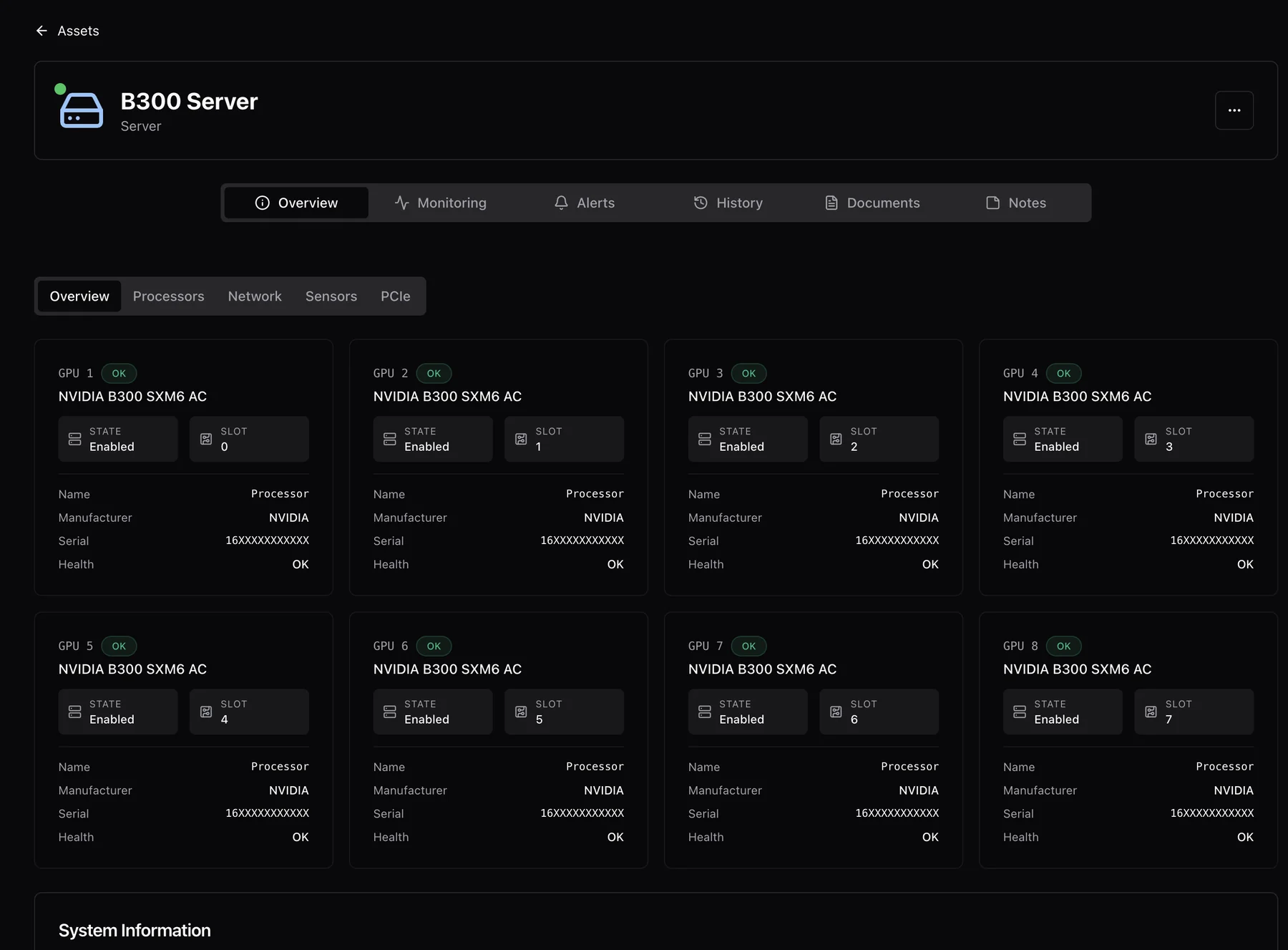
GPU identity
H100 80GB HBM3 verified by serial number.
Health status
OK or fault status per GPU, live.
Thermal data
Live temperature per GPU.
Server context
Host identified as a Dell PowerEdge XE9680.
For lenders
Why server-level data matters for credit
For a lender, server-level data turns a GPU from opaque hardware into a verifiable financial asset.
Continuous confirmation
The collateral exists and is running, confirmed continuously.
Auditable records
Infrastructure records tied to each credit position.
Less reliance on trust
Verified data replaces reporting taken on trust.
The transparency layer
Between the hardware and the credit protocol
Aravolta sits between the physical hardware and the credit protocol. It verifies continuously and never touches a workload.
- 1
GPU hardware
H100s, with their serial numbers and health data.
- 2
Aravolta
Infrastructure-level verification.
- 3
USD.AI Protocol
Credit positions and lender dashboards.
The result
Continuous verification for each credit position
USD.AI now has a lending structure where verification is ongoing rather than event-driven.
Live visibility
Collateral is visible live instead of at audit time.
Live infrastructure data
Live readings replace assumptions.
Verification that scales
Verification keeps up as credit positions grow.
Lending against GPUs?
Talk to an engineer on a 30 minute call with our infrastructure team.
Book a demoMore case studies
See all Modular DC
Flexnode
Aravolta DCIM Live at the Flexnode Modular Data Center in Weeks
“...by far the easiest setup and the most impressive monitoring system I've encountered.”
Dr. Martin Rapos, EVP, Flexnode
 Colocation
Freedom Data Centers
From Dark Facility to Full Network Control: 138 Devices Secured in 5 Days
“...urgency and execution... deployed same day... worked around the clock until the job was done.”
Carl Noriega, Managing Partner, Freedom Data Centers
 AI Infrastructure
Leading ASIC Manufacturer & Cloud Provider