
Every time a technology chart goes vertical, the bubble chorus starts up. It sang for railroads in the 1880s and for the internet in the late 1990s, and it is singing now for generative AI. This time we think it has the wrong analogy.
The story is easy to tell: too much money chasing too few ideas, so a collapse is only a matter of time.
The data says something else. Look at who is building, how it is funded, and what the capacity is used for, and the buildout stops looking like a bubble.
There is over-exuberance and misallocated capital here, as in every growth market. There is also a supply-side crunch that has not let up, because what AI needs keeps changing: cooling requirements move, and a new chip generation lands every six months.
We are not burying fiber in the ground and hoping someone invents Netflix later.
Across the GPU-dense sites we monitor at Aravolta, the picture is the same: new clusters fill as soon as they come online, power is scarce, and operators are racing to stand capacity up, not tear it down.
This is less a tech boom than the early industrialization of cognition: a capital intensive, energy constrained expansion that lowers the marginal cost of reasoning itself. Wall Street analysts do not yet know how to price what machine intelligence does to an economy, and we do not blame them.
Unlike the internet era, this buildout needs several scarce inputs at once: chips, energy, research, and machine intelligence turned back on the problem of making more machine intelligence. We have crossed the Rubicon on the road to AGI, and nobody is marching back.
Plenty of people will turn out to have made the wrong bet on the wrong technology at the wrong time, and that capital will be wiped out. The principle behind “scale-pilling” survives them: more compute means smarter models, which (eventually!) turns into GDP once the dust settles.
Start with where the scaling argument came from, because that is what the market is reacting to.
A brief history of scale-pilling
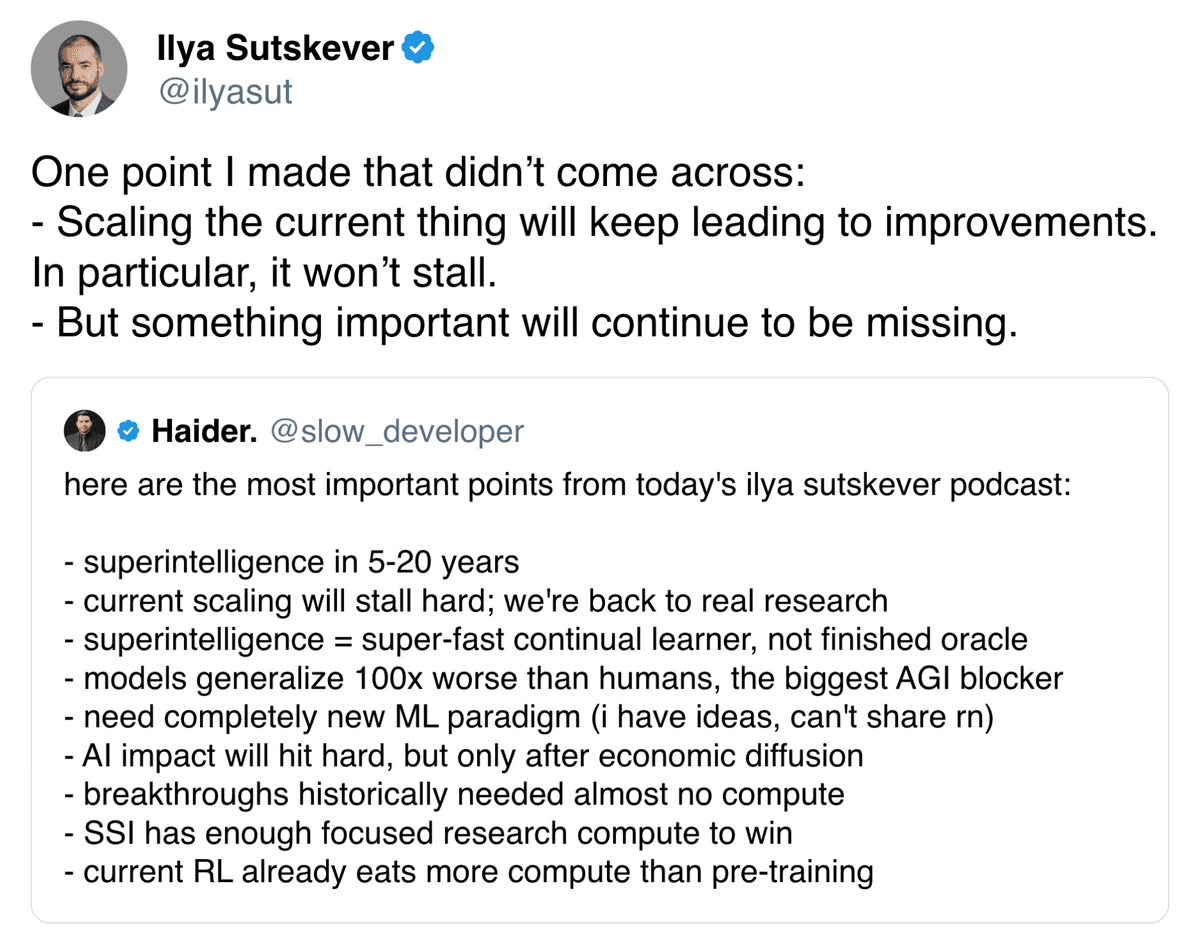
By history we mean 2023 and 2024, the stretch we call “The Age of Scaling.” Dylan Patel popularized the idea on the Dwarkesh podcast, Ilya Sutskever and plenty of other researchers backed it, and Rich Sutton's 2019 essay “The Bitter Lesson” had already argued that compute beats clever algorithms. In March 2023, after the GPT-4 demos, an X thread by Andrej Karpathy quipping that “scaling is the new black” went viral. The belief underneath all of it was that we could not afford not to build, build, build.
And nobody wants to be left out of that equation.
For more than a year, “just scale it” was the industry's working assumption, close to an article of faith. So when serious people questioned it, the doubt spread fast: if scaling is not the only lever, the economics of the whole buildout have to be re-run. That is the backdrop for why markets reacted so violently.
Which is why Ilya's comment on Dwarkesh last week landed the way it did: “Scaling is not enough”. Add Nvidia falling after beating earnings, a bearish tape, and Michael Burry headlines calling a bubble, and you have today's climate.
What the debate misses is that two things can be true at once:
- Machine intelligence does not scale linearly with cluster size. There are diminishing returns.
- AI will work its way into every corner of the economy, and that takes more compute every year, even as each unit of compute gets more efficient.
Railroads, fiber, and GPUs
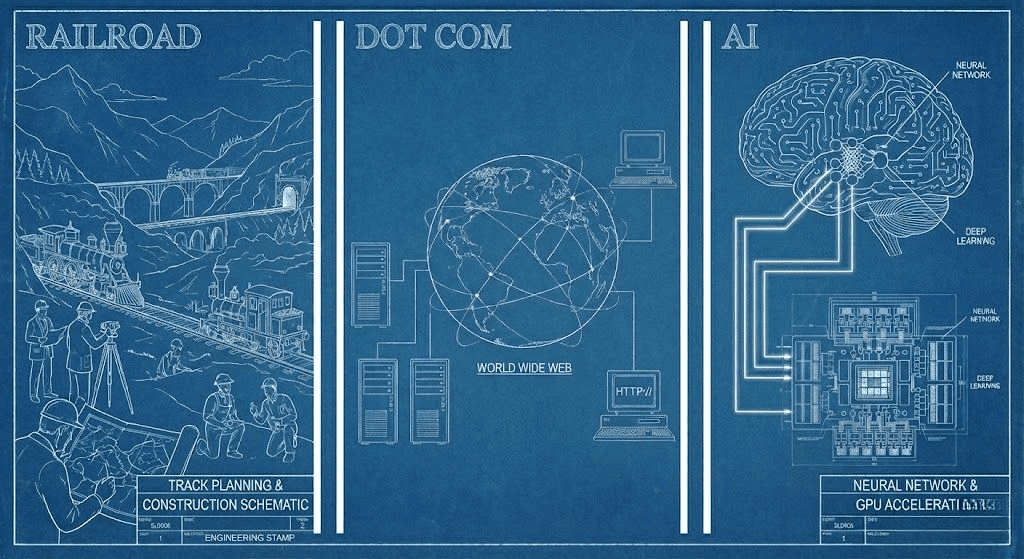
To judge a bubble, ignore the hype. Look at CapEx as a share of GDP, at the physical supply constraints, and at what the economy eventually gets for the money.
- We have already passed the dot-com era's infrastructure intensity.
- We are heading toward railroad-era intensity, with much tighter physical constraints and much more immediate utility.
- And unlike fiber after DWDM, there is no trick that multiplies GPU capacity.
Infrastructure intensity and outcomes across eras
| Era | Primary Asset | Peak Investment (% of GDP) | Supply Constraint | The Economic Outcome |
|---|---|---|---|---|
| Railroads (1870s to 1890s) | Physical Track | ~6% | Land Rights & Steel | Massive investor wipeouts, then an eventual ~25% uplift to U.S. GDP through freight productivity and land value. |
| Telecom (1996 to 2001) | Fiber Optics | ~1% | Capital (Until DWDM) | Utilization fell to ~1% and prices went to zero. The value showed up 15 years later, with Web 2.0. |
| AI (2025 Projected) | GPU / Energy | ~1.4% | Energy & Packaging | Labor substitution and software automation pay back in OpEx right away. To justify capex at this scale, AI only needs to generate ≥0.4 to 0.6%*. |
* Economists use a 3 to 5 year window because that is the typical productive life of technology capital, and the historical span over which new infrastructure shows up in GDP. GDP figures from Investment Research Partners.
The takeaway: the telecom bust happened at about 1% of GDP with almost nobody using the fiber. We are past that intensity and heading toward “railroad” territory, with tighter physical constraints and capacity that is spoken for before it energizes.
Demand: forecast versus backlog
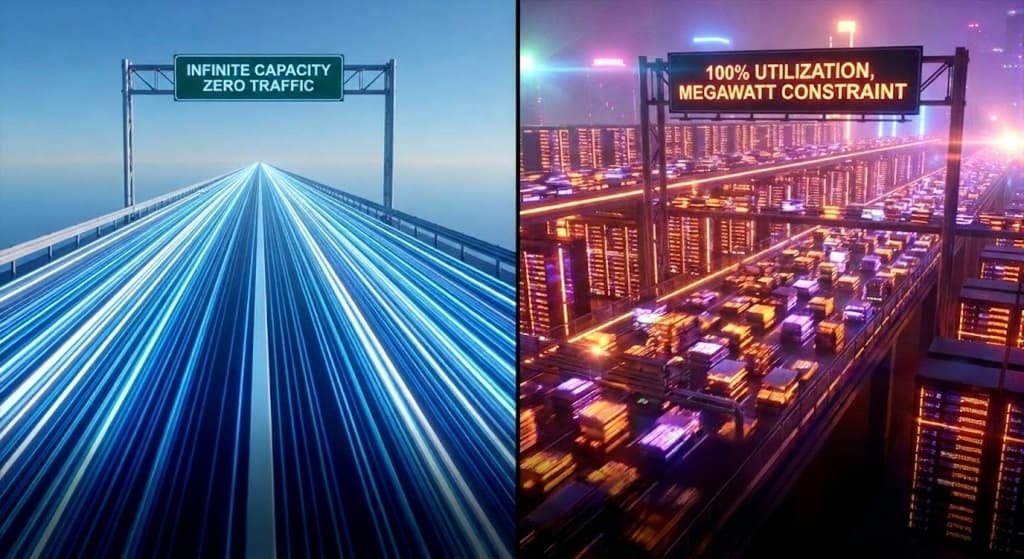
The biggest difference between 2000 and 2025 is how demand shows up.
2000: forecast-driven fiber
In 1999, Global Crossing and friends trenched fiber across oceans on the strength of models that said internet traffic would double every 100 days. Then DWDM let operators push 100x more data down the same glass, supply became effectively infinite, and bandwidth prices fell through the floor. Utilization on many networks sat around 1 to 3 percent. They built the highway before the cars existed, then found out the highway could be widened for free.
Today: backlog-driven compute
Now the sequence runs the other way:
- Silicon is pre-sold. Nvidia's Blackwell generation is sold out for the next 12 months on firm orders from hyperscalers who are fighting each other for allocation. Nobody is counting “pipeline interest” in that number.
- Capacity is pre-leased. In core US markets like Northern Virginia, vacancy is under 1%, and roughly 70% or more of the capacity under construction is leased before the slab is poured. Many colo projects do not break ground until a credible customer has signed and the energy lease is in hand.
Why you can't multiply a GPU
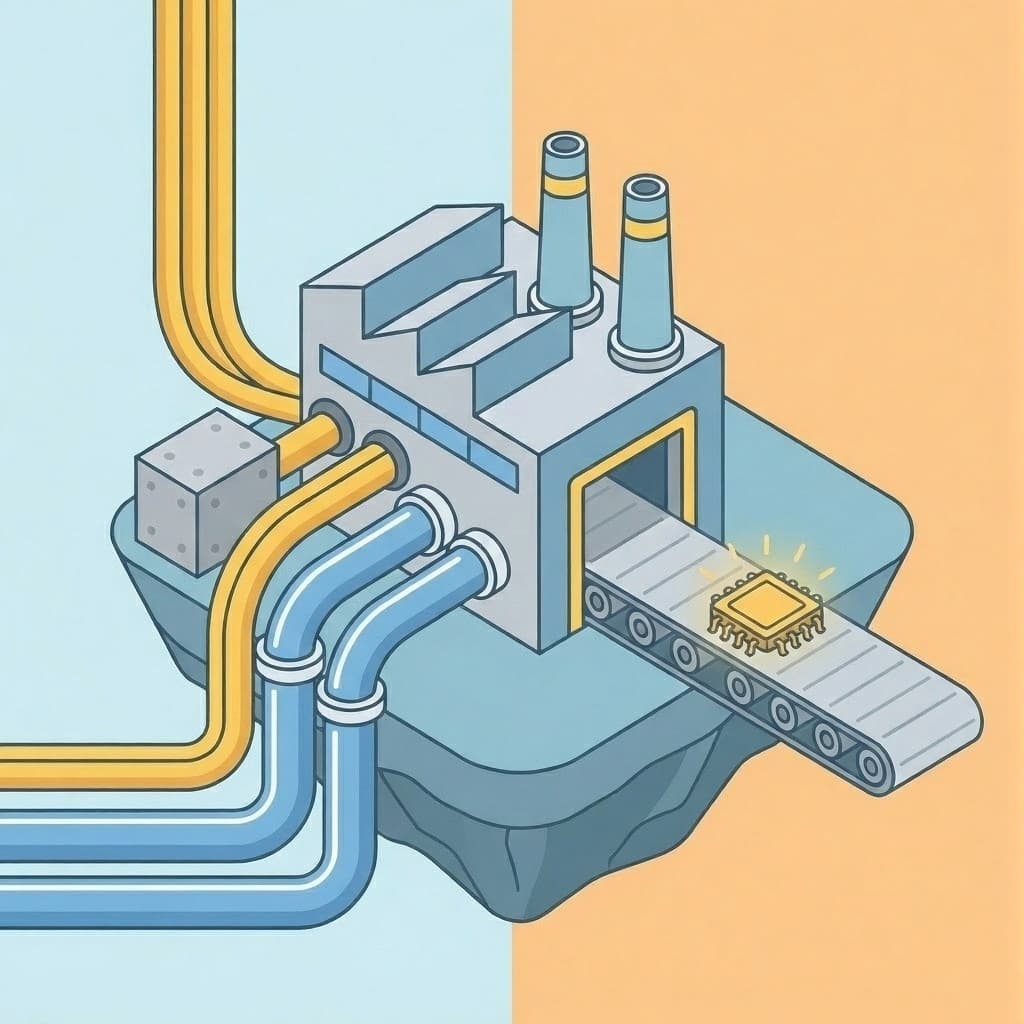
The telecom bubble popped because of one technology. Dense Wavelength Division Multiplexing (DWDM) let operators multiply network capacity without laying more glass, so the bottleneck disappeared overnight and prices followed it down.
AI compute has no equivalent “free multiplier”:
- You cannot push a firmware update and make an H100 do 100x more FLOPs.
- Scaling takes new wafers, new CoWoS capacity, new HBM, new racks, and new megawatts. All of it costs real money and takes real time. Newer architectures (Cerebras wafers, Recogni accelerators, TPUs, and other domain-specific chips) may cut compute-per-watt by a meaningful amount, but they arrive as new deployments rather than upgrades to silicon already in the rack. None has shown anything like the 10 to 100× supply-side jump DWDM gave fiber.
- Lead times on high-voltage transformers run 3+ years. Fabs take most of a decade. Transformers, switchgear, and cooling are real bottlenecks, and for the operators we work with at Aravolta, speed to market now matters as much as the megawatts themselves. When the first operator in a market stands up a liquid-cooled, power-dense hall, tenants line up for it. That is why operators use platforms like ours to speed up provisioning and site readiness, and to shorten the stretch between “hardware delivered” and “GPUs online and billing.”
There is a hard scarcity floor: in 2000, capacity could explode with a software and optics upgrade. In 2025, capacity grows on 24 to 36 month cycles tied to fabs, power, and grid upgrades.
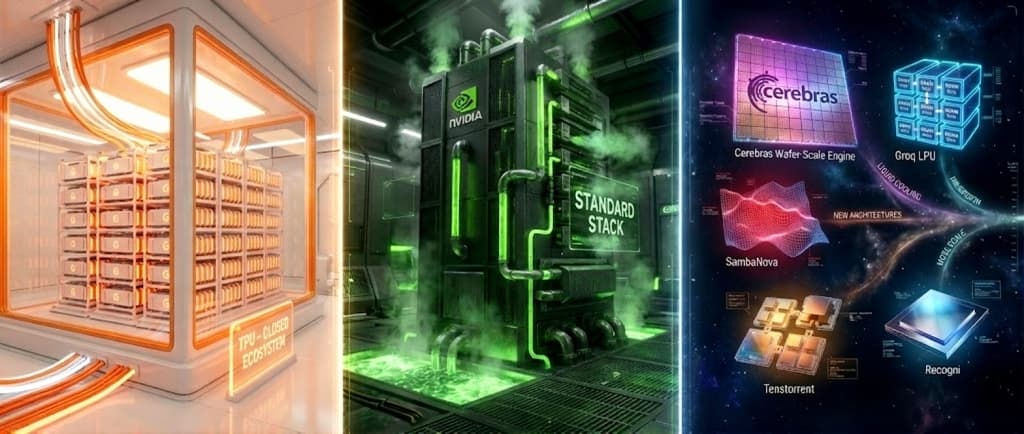
TPUs are not the only innovation
The question underneath all the Nvidia discourse: if scaling is slowing and demand is exploding, where does the next supply-side breakthrough come from?
The industry likes to fixate on Google's TPUs, especially now that Gemini trains on them. But Google has more reason to make Gemini better than to turn TPUs into a product anyone can buy. That leaves a wide opening.
Behind the scenes, a wave of alternative architectures is building: wafer-scale engines, LPUs, reconfigurable dataflow chips, RISC-V chiplets. Calling these companies “competitors” undersells them. They are the only plausible path to a 10× to 30× improvement in compute-per-watt, and if one of them hits, the whole supply chain shifts. So it is worth looking at who is real and what they are shipping.
| Company | Key Innovation (2025) | Performance Edge vs. Nvidia | Role in AI Ecosystem | Funding/Valuation |
|---|---|---|---|---|
| Cerebras | Wafer-Scale Engine-3 (WSE-3): 900K cores, 4T transistors on a single 46x46mm wafer; 7,000x GPU memory bandwidth. | 179x faster molecular sims than Frontier supercomputer; 1/6th power for inference (Llama2-70B in 1 day). | Training/inference for pharma (GSK agents) & UAE's Condor Galaxy; 6 new datacenters. | $1.1B raise; $8.1B val; TIME's 2024 Best Invention. |
| Groq | Language Processing Unit (LPU v2): SRAM-centric TSP with 80 TB/s on-die bandwidth; speculative decoding for 2-4 tokens/stage. | 500+ tokens/s on Mixtral 8x7B (13x ChatGPT); 10x energy efficiency for LLMs. | Real-time inference (McLaren F1 analytics); GroqCloud API beats H100 latency. | $750M raise; $6.9B val; $1.5B Saudi commitment. |
| Recogni | Pareto math for mixed-precision (up to 16-bit) inference; no QAT needed for >100B param LLMs. | 1 petaFLOPS Scorpio chip: 300m object detection accuracy; gen2 for datacenter scale. | Edge-to-cloud inference; $102M for automotive/enterprise. | $175M total; gen2 focus on LLMs. |
| SambaNova | SN40L RDU: Reconfigurable dataflow with 1 TB/s/node; multi-core compute-storage array. | Fastest Llama 3.1 405B inference; 30x request serving boost. | Enterprise Suite for agentic AI; SoftBank Japan datacenters. | $1B+ total; “Most Respected Private Semi” 2024. |
| Tenstorrent | Wormhole/Blackhole: RISC-V chiplets with Metalium compiler; Ascalon CPU for SPECINT. | A100 parity at lower power; scalable to Galaxy servers. | Open-source licensing; Bezos/Fidelity-backed for ADAS. | $700M Series D; $2.6B val. |
Still, Zarbot (English translation by @jukan05) put the counterargument best:
“Nvidia's success goes far beyond the GPU hardware itself. Its true moat is the entire complex, ubiquitous accelerated computing solution. As Jensen said, they excel in scientific and engineering simulation, computer graphics, structured data processing, and classical machine learning. And the ‘single architecture’ covering from cloud (training) to edge devices (inference) means developers can use one set of code and toolchains to serve all scenarios. This development efficiency and ecosystem consistency are difficult for competitors to replicate in the short term.”
No one holds a lead forever, though who the big winners are, and on what time scale, remains to be seen.
What it means for the buildout is also open. Will we still need liquid cooling, or move to immersion? Will chip innovations cut the energy need by much, or will we just deploy more of everything?
When would this become a bubble?
To be fair, this can still go wrong. But “AI mentions on earnings calls” and “Nvidia's stock multiple” are the wrong gauges. A real AI infrastructure bubble needs at least two of the structural breaks below.
Colocation markets are a good read on enterprise activity, so start there.
North America colocation market (H2 2024)
| Metric | Value |
|---|---|
| Inventory | 13.6 GW |
| Vacancy | 2.6% |
| 2024 Absorption | 4.4 GW |
| 2024 Completions | 2.6 GW |
| Under Construction | 6.6 GW |
| Planned | 22.9 GW |
Colocation rents by contract size (H2 2024)
| Contract Size | USD/kW/mo |
|---|---|
| <250 kW | $318 |
| 250 kW to 1 MW | $201 |
| 1 to 5 MW | $152 |
| 5 to 20 MW | $139 |
| >20 MW | $126 |
Key primary markets: inventory and vacancy (H2 2024)
| Market | Inventory (MW) | Vacancy | 2024 Net Absorption (MW) |
|---|---|---|---|
| Northern Virginia | 2,930 | 0.5% | 452 |
| Dallas-Fort Worth | ~1,200 | <2% | ~500 |
| Atlanta | 1,000 | ~2% | 706 |
| Chicago | ~800 | ~3% | ~300 |
| Silicon Valley | ~600 | 5.5% | ~200 |
| Phoenix | 603 | ~4% | ~150 |
Notes: Northern Virginia is still the largest market, Atlanta led absorption in 2024, and vacancy is at record lows across the primary markets (1.9% overall). Source: CBRE H2 2024 report.
Every market signal (vacancy, absorption, rents, power availability) says the same thing: we are structurally short on capacity, not long. There is no oversupply anywhere in the stack.
The bubble dashboard
| Metric | Bubble Condition (“Crash” Signal) | Current Status (Late 2025) |
|---|---|---|
| Vacancy Rates | Data center vacancy in primary hubs (e.g., NoVA) spikes above 10%. | Northern Virginia vacancy is <1%. There is almost no space to lease. |
| Spot Pricing | Hourly rental for H100 GPUs crashes below electricity cost (e.g., <$1.50/hr). | Spot prices have settled at $2.85 to $3.50/hr, which says supply and demand are in balance. |
| Value Realization | Companies spend billions with zero measurable revenue uplift. | Revenue expansion and OpEx reductions confirmed in Q3 2025 earnings (see below). |
None of these conditions exist today. Every one of them points the other way. The Q3 2025 earnings prints show the “revenue expansion” phase has begun, and the intelligence those chips produce is now showing up as revenue.
- Cursor: Fastest SaaS company ever to reach $1B ARR, in 24 months.
- JPMorgan: AI coding tools lifted productivity 20% across 60,000+ technologists.
- Walmart: AI saved 4 million developer hours, about 2,000 full-time work years. AI route optimization cut 30M unnecessary miles and 94M lbs of CO₂.
- Meta: The AI-driven “Advantage+” ad engine now runs at a $60B+ revenue run rate, with ad impressions up 14% and ad prices up 10% at the same time.
- Adobe: AI-related revenue passed $5B, and Firefly AI-first ARR is approaching $500M.
- Salesforce: Closed 5,000 Agentforce deals within months as enterprises replaced old chatbots. Internal data puts resolution at 84% with 2% human escalation.
- Duolingo: Launched 148 AI-generated language courses in one year, work that used to take decades. The “Duolingo Max” AI tier lifted ARPU 6%, alongside 51% user growth.
- ZipRecruiter: AI cut time-to-hire by up to 30% and improved screening efficiency for 64% of recruiters.

The two-market reality: froth versus bedrock
Stop treating AI as one asset class. There are two markets here, and only one of them is behaving like a bubble.
Layer 1: the consumer layer
Skepticism makes sense here. Thousands of startups raised money in 2023 to build thin interfaces around foundation models, and most of them will not survive.
- Many analysts expect 85 to 90 percent of these companies to fail within three years.
- Moats are thin and churn is high.
- Most of them run entirely on someone else's models and infrastructure.
- The foundation model providers are moving up the stack. They watch what works on their own platforms and then build it themselves.
- It is the Amazon Basics playbook. Startups test the market; OpenAI, Anthropic, and Google watch the usage data for which workflows take off, then ship their own version at platform scale. Rewind, Adept, Jasper, and plenty of others learned this the hard way.
Still, this layer is already producing durable winners.
- New tech giants like OpenAI and Anthropic are here to stay.
- A new generation of AI-native software companies (Cursor, Lovable, and others) is posting real revenue and growing faster than the early SaaS leaders did.
- As in the dot-com era, most will die and a few will become generational companies.
Even the failures help. Every dead startup spent its venture dollars on GPU compute first, so it ended up subsidizing the infrastructure layer.
Layer 2: the infrastructure utility layer
This layer is different. It is the data centers, the power, the cooling, and the silicon, and it behaves like a utility rather than a speculative bet.
- The spend becomes a recurring operating cost, like electricity or cloud storage. We see that stickiness in our own data at Aravolta: once an operator has instrumented power, cooling, and asset lifecycle workflows with us, they expand the footprint rather than rip it out. AI infrastructure behaves like a utility stack, and the operational software on top of it behaves the same way.
- Infrastructure providers get long, sticky usage from customers across industries.

National security and the race to sovereign AI
If the private market slows, the government becomes the buyer of last resort for AI infrastructure. The examples are piling up: the Genesis Mission, which has been likened to a modern Manhattan Project, and a large federal commitment of cloud resources.
Climate change seems to have fallen off the public agenda, replaced by a rush to own the intelligence layer. Project Stargate and the recent AWS federal commitments treat compute as a national security asset rather than a commercial commodity.
That puts a hard demand floor under the buildout, one that does not depend on consumer hype.
The sovereign “put option”
While VC Twitter debates whether chatbots have product-market fit, the federal government is underwriting the physical buildout.
- The $50 billion anchor: AWS announced a $50 billion investment in US government and defense regions (Top Secret, Secret, and GovCloud). That is 1.3 gigawatts of capacity, roughly one nuclear reactor's worth of power, set aside for national security.
- The Genesis Mission: an executive order launched a “Manhattan Project” for AI, directing the DOE and the national labs to build “scientific foundation models.” No startup is chasing revenue here. This is the state nationalizing the science layer of AI.
Government checks for power do not buy efficiency on their own. If the US is serious about adding AI capacity fast, chips and megawatts are only part of it. It also needs the software layer that turns a physical data center into a productive AI factory.
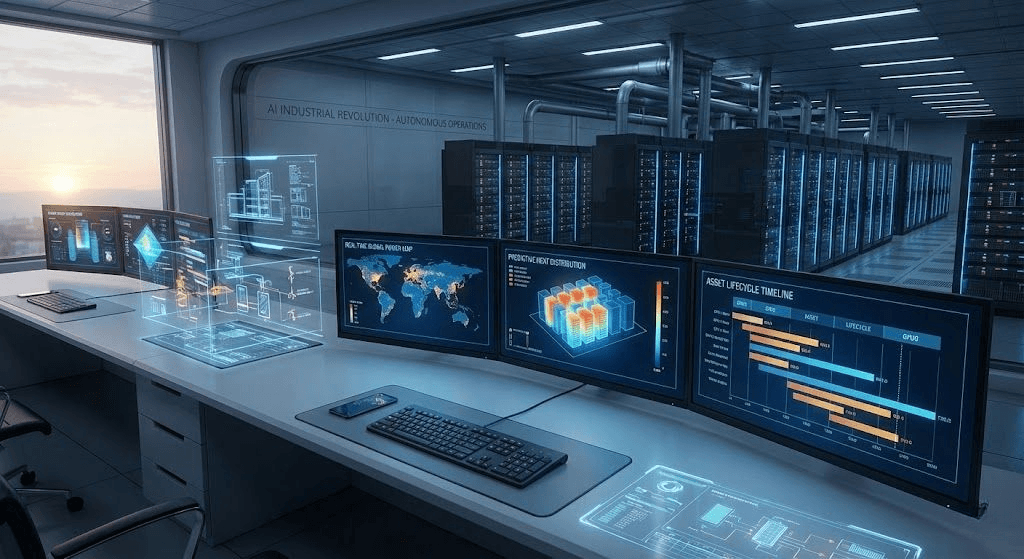
We are moving from “build at all costs” to “operate with precision.” Whether the buyer is a hyperscaler or the Department of Defense, the question is the same: is this hardware doing useful work, or is it cooking under thermal stress?
That is the layer Aravolta is building. We supply the telemetry that tells an operator what each megawatt and each GPU is doing.
Conclusion
Zoom out and this does not look like the dot-com era. It looks like the start of a new industrial revolution: slow, physical, expensive, and inevitable.
The risk for the United States is not that it builds too much.
The risk is that it builds too slowly and lets another country become the world's cognitive superpower.
“Is this a bubble?” is the wrong question. The one worth asking is how we get more compute, more megawatts, and more useful work out of every cluster before someone else does. That takes a new kind of operational software, the layer that helps GPU data centers get more work out of every megawatt. That is what we are building at Aravolta.
Frequently asked questions
Is the AI infrastructure buildout a bubble?
No. Unlike the dot-com bubble, AI infrastructure shows no sign of oversupply. Northern Virginia vacancy is below 1%, data center rents are up 32 to 60% year over year, H100 spot prices sit at $2.85 to $3.50/hr, well above the cost of electricity, and Cursor, JPMorgan, Walmart, and Meta are all reporting measurable revenue or productivity gains from AI.
How much are companies investing in AI infrastructure?
Hyperscaler CapEx is running at $260B+ per year and accelerating: Amazon is investing $100B in 2025, Microsoft $80B, Google $75B, and Meta $60 to 65B. Global data center investment is projected to pass $1.2 trillion by 2030. The spend is turning into a recurring operating cost, like electricity, rather than a one-time bet.
What is the difference between the AI consumer layer and infrastructure layer?
The consumer layer (startups building interfaces around foundation models) looks like a bubble: 85 to 90 percent of them may fail within three years. The infrastructure layer (data centers, power, cooling, silicon) behaves like a utility, with sticky usage, long-term contracts, and a demand floor set by national security spending. They are different markets and should be judged separately.
Why is AI infrastructure considered a national security asset?
The US government treats compute as a strategic resource. AWS announced $50B for government and defense regions (1.3 GW of capacity), the Genesis Mission executive order launched a Manhattan Project for AI, and Project Stargate treats compute as a national security asset. That puts a demand floor under the buildout that does not depend on consumer hype.
What are current data center vacancy rates?
As of H2 2024, vacancy is at record lows: Northern Virginia 0.5%, Dallas-Fort Worth under 2%, Atlanta about 2%, Chicago about 3%, Silicon Valley 5.5%, and Phoenix about 4%. Across the primary markets it is 1.9%. New supply is absorbed faster than it can be built; Atlanta alone absorbed 706 MW in 2024.
What is the biggest constraint on AI infrastructure growth?
Power. PJM Interconnection, the largest US grid operator, has 40 GW of new data center interconnection requests in front of it, and FERC recently rejected a nuclear-powered data center interconnection proposal. Grid upgrades often take 5+ years, so supply cannot keep pace with demand.
How does Aravolta fit into the AI infrastructure stack?
Aravolta is the operational software layer between the physical data center and the AI workload. As the industry moves from build at all costs to operate with precision, operators need telemetry that shows whether hardware is doing useful work or burning out. Aravolta supplies power monitoring, GPU telemetry, asset management, and compliance reporting for the 1 to 100 MW segment.
Last updated: March 2026
Sources and citations
- NVIDIA H100 Price Guide 2025 - Jarvis Labs
- Nvidia's Blackwell GPUs are sold out for 12 months - Tom's Hardware
- Problem/Opportunity Statement - PJM.com
- FERC Rejects Interconnection Proposal for Nuclear-Powered Data Center Project - Pillsbury Law
- Saudi Arabia's $100B AI Revolution: Project Transcendence - ColonyByte
- BlackRock, Microsoft and MGX AI Partnership - Microsoft
- Announcing The Stargate Project - OpenAI
- Genesis Mission AI Initiative - AP News
- PJM Load Forecasting Comments - Maryland Office of People's Counsel
- Why Most AI Startups Will Fail in 2025 - Dev.to
- Amplified Gains from Transportation Infrastructure Investments - Northwestern
- Projected Impact of Generative AI - Penn Wharton Budget Model
- AI factories face a long payback period - SiliconANGLE
- Walmart Generative AI Agents - CIO Dive
- AI-Powered Supply Chains - Gain Consulting
- Meta AI Marketing Efficiency - Marketing Dive
- Adobe Investor Relations - Adobe
- FY25 Q4 Earnings - Salesforce
- Duolingo's AI-First Strategy - Chief AI Officer
- AI in the Recruiting Industry Statistics - Zipdo
- The AI Spending Boom Is Massive, But Not Unprecedented - Bloomberg
- Google TPU Expert Call - SemiconSam
- GDP Figures - Investment Research Partners